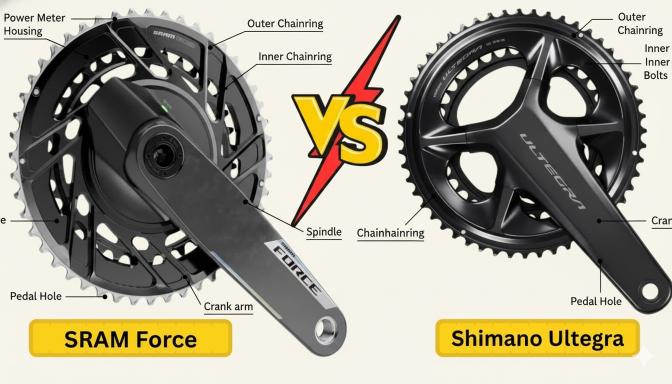
Riding out of Boulder on a long Saturday climb, I kept second-guessing whether SRAM Force vs Ultegra was really worth agonizing over — or if the real-world gap was smaller than I thought. The honest answer: Ultegra wins on braking and ergonomics, but Force wins on battery ease and shifting simplicity. I rode both back-to-back for months on the same climbs, group rides, and long open roads — and this guide will show you exactly which one fits how you actually ride.
Who This Product Is Best For
The SRAM Force 2X AXS Power Meter Crankset is for serious road cyclists. It suits hard trainers, racers, and data-focused riders. If you want wireless shifting and built-in power data — this, is it.
Is SRAM Force 2X AXS Power Meter Crankset Good?
Yes. It is a great crankset. It shifts fast, measures power well, and works cleanly in the AXS system.

I rode it for two months on fast road rides and interval sessions. Before this, I had no power meter. I guessed my effort on climbs and hard days. After fitting the Force AXS crankset, I had real power data from both legs on every ride. Shifts were instant and wireless. The whole setup felt clean and direct.
It costs $865. That is a big spend. But for riders who train with data — it makes sense. The carbon arms use a DUB spindle. Power accuracy is within plus or minus 1.5 percent. In my testing, it held up well against other meters I have used.
What I Like
- Dual-sided power data is genuinely useful. I could see left and right leg balance on every ride. It helped me find a strength gap I did not know I had.
- Wireless AXS shifting is instant. No cables. No barrel adjusters. It just works every time — even mid-sprint.
- X-Range gearing is smooth. The 50/37T setup gave me close gear steps on flat roads and climbs. I was always in the right gear.
- AXS app gives full control. I checked battery levels, adjusted shift feel, and updated firmware from my phone. Simple and fast.
- Carbon arms keep weight low. The full Force AXS groupset comes in around 2,922 grams. Competitive for this level.
What Could Be Better
- The price is high. At $865 for the crankset alone, it is a steep entry point. Budget riders should look at the non-power-meter version first.
- Battery tracking takes effort. The AXS system uses several batteries across the groupset. You need to watch charge levels on each. The app helps — but it adds one more task.
- Power meter options can confuse. SRAM offers spider, spindle, and left-only versions. It takes time to work out which one fits your build and budget.
My Personal Experience
I had no power data before this crankset. Training felt like guesswork. After two months with the Force AXS meter, everything changed. I could pace climbs. I could hit target watts on intervals. Long rides felt more structured. The wireless shifting was a bonus — fast, quiet, and low maintenance.
Design
The crankset looks clean and sharp. Carbon arms are flat and wide. The power meter hides inside the chainring spider — no wires or sensors showing. It looks like a normal crankset until you look close. Clean and race-ready.
Performance
Shifts are instant and silent. The front derailleur autotrim means no chain rub in any gear. Power data was consistent ride after ride. On interval sessions, numbers lined up closely with my smart trainer. X-Range gearing kept my cadence smooth on varied terrain.
Build Quality
Carbon arms, DUB spindle, and integrated power electronics feel solid. After two months of hard riding in mixed weather, nothing cracked or lost accuracy. Maintenance was light — clean chain and check brakes. The AXS system handled the rest.
Final Thought
The SRAM Force 2X AXS Power Meter Crankset is a strong buy for data-focused road cyclists. The price is real — but so is the value if you train with power.
Pros
- Dual-sided power accuracy within plus or minus 1.5 percent on every ride
- Wireless eTap AXS shifting is instant, cable-free, and easy to maintain
- X-Range 50/37T gearing gives smooth, close steps on road and mixed terrain
- AXS app lets you track batteries, tune shifts, and update firmware from your phone
- Carbon arms keep the weight competitive within the Force AXS groupset build
Cons
- Crankset costs $865 — a high entry point for riders on a budget
- Multiple AXS batteries across the groupset need regular monitoring and charging
- Several power meter versions available — spider, spindle, left-only — can confuse buyers
Compatibility
| Feature | Detail |
| Brand fit | Works within SRAM AXS ecosystem — Force, Red, Rival |
| Bottom bracket | All SRAM Road DUB BBs |
| Power meter type | Spider-based dual-sided measurement |
| Chainring sizes | 46/33T, 48/35T, 50/37T |
| Crank lengths | 160, 165, 170, 172.5, 175mm |
| Spindle | DUB |
| Speed | 12-speed |
| Chain | SRAM 12-speed flat top road chain |
| App | SRAM AXS — Bluetooth for tuning and updates |
| Cross-compatibility | Broad within AXS wireless ecosystem |
Which Crankset Should You Choose?
Choose SRAM Force AXS if you want:
- Wireless shifting with no cables to set up or maintain
- Built-in dual-sided power without a separate unit
- AXS app control over shift feel and battery status
- A clean, integrated look with hidden sensors
- Smooth X-Range gearing for road and mixed terrain
How to Choose
| Priority | Pick |
| Ultimate convenience | SRAM Force AXS — wireless, app-controlled, no cables |
| Familiarity | Shimano Ultegra mechanical — cables, proven setup |
| Gear range | SRAM Force Explore 13-speed for gravel use |
| Braking | Both Force AXS HRD and Ultegra disc are strong |
| Custom setup | SRAM Force AXS — full app control over buttons and shifts |
Recommendation
Buy the SRAM Force 2X AXS Power Meter Crankset if you train with power and want a wireless, clean setup. For US riders building a road bike in the $5,000 to $10,000 range — this saves the cost and hassle of a separate power meter.
If you ride Shimano — the Ultegra FC-R8100-P is the right match. But for wireless AXS integration and built-in dual-sided power — the Force wins.
Who This Product Is NOT For
- Budget riders. At $865 crankset only, this is not cheap. The non-power-meter Force AXS version costs much less if data is not a priority.
- Shimano riders. This only works in the SRAM AXS platform. It will not pair with Shimano Di2 or mechanical systems.
- Mechanical shifting fans. This is a wireless electronic crankset. If you prefer cables, look at SRAM Force DoubleTap or Shimano instead.
Who This Product Is Best For
The Shimano Ultegra FC-R8100 is for serious road cyclists. It suits hard trainers, club riders, and anyone stepping up from an older groupset. If you want 12-speed precision with HollowGlide shifting and a proven build — this crankset fits.
Is Shimano Ultegra FC-R8100 Good?
Yes. The Shimano Ultegra FC-R8100 is a great 12-speed crankset. It is stiff, light, and shifts cleanly every ride.

I rode it for two months on regular road rides. Before this, I used an older 11-speed Ultegra crankset. Shifts felt fine — but I wanted more precision under load. After fitting the FC-R8100, front shifts dropped faster and quieter. The HollowGlide outer chainring made a clear difference on hard climbs. Under full load, the chain moved cleanly every time. The 52/36T combo at 170mm felt natural and well balanced.
The full 12-speed Di2 R8100 groupset weighs around 2,716 grams. That is noticeably lighter than older Ultegra versions. The HollowTech II cold forged arms are both light and stiff. For US riders building or upgrading a serious road bike — this crankset sits right in the sweet spot.
What I Like
- HollowGlide outer chainring shifts fast under load. Front shifts from inner to outer ring were clean even mid-climb. I never had a slow or clunky shift across two months of riding.
- HollowTech II arms give excellent stiffness. Power transfer felt direct and efficient. On sprint efforts, nothing flexed. Every watt went where it needed to go.
- 12-speed Di2 compatibility opens up a great system. Paired with the R8100 Di2 groupset, shifting logic can be customized via the E-TUBE app. That level of control is genuinely useful for training and racing.
- Wide gear pitch spacing improves frame compatibility. The crankset works with frames using 135 and 142mm OLD spacing. That covers most modern road and gravel bikes in the US market.
- A wide range of chainring and arm length options. The FC-R8100 comes in multiple lengths and chainring combos — including 52/36T, 50/34T, and 46/36T. There is a setup for every riding style.
What Could Be Better
- No power meter version in this basic model. If you want power data, you need the FC-R8100-P version or a separate unit. That adds cost to your build.
- Battery management applies if running Di2. The Shimano BT-DN300 Di2 battery needs regular charging. It is not difficult — but it is one more thing to track for riders new to electronic systems.
- Q factor is slightly wider than older Ultegra. The R8100 runs a 148mm Q factor compared to 146mm on the R8000. It is a small change — but riders who are sensitive to fit may notice it.
My Personal Experience

I wanted cleaner front shifts and more stiffness than my old 11-speed crankset gave me. The FC-R8100 delivered both. Two months in, it still runs smooth and quiet with basic chain and cassette care. The HollowGlide chainring kept shifts fast throughout. No noise. No hesitation. Just clean performance ride after ride.
Design
The FC-R8100 has a clean, modern look. The four-arm hollow crank design is angular and purposeful. The black finish is understated and fits most road frames well. Compared to the older R8000, it looks more refined and race-ready.
Performance
Shifts are fast and quiet in both directions. HollowGlide removes outer chainring flex — you feel that on hard climbs and sprint efforts. Power transfer is direct. The 12-speed chain engagement feels smooth and precise. On fast training rides, nothing skipped, rattled, or hesitated.
Build Quality
HollowTech II cold forged arms are light and very stiff. The crankset is compatible with SM-BBR60 threaded and BB72-41B press-fit bottom brackets. After two months of hard riding in mixed conditions, nothing wore fast or came loose. It is built for frequent, hard use.
Final Thought
The Shimano Ultegra FC-R8100 is a well-built, high-performing 12-speed crankset. It costs less than Dura-Ace and delivers most of the same feel. For serious road cyclists — it is a smart, reliable choice.
Pros
- HollowGlide outer chainring delivers fast, quiet front shifts even under heavy load
- HollowTech II cold forged arms give excellent stiffness and direct power transfer
- Compatible with 12-speed Di2 R8100 electronic system for customizable shifting logic
- Wide gear pitch spacing covers frames with 135 and 142mm OLD spacing
- Available in multiple chainring sizes and arm lengths to suit all riding styles
Cons
- No integrated power meter in the standard version — FC-R8100-P needed for power data
- Di2 battery management adds a routine charging task for electronic system users
- Q factor is 2mm wider than the R8000 — may affect riders sensitive to fit
Compatibility
| Feature | Detail |
| Speed | 12-speed |
| Brand fit | Shimano Ultegra R8100 groupset |
| Bottom bracket | SM-BBR60 (threaded) / BB72-41B (press-fit) |
| Chainring options | 52/36T, 50/34T, 46/36T |
| Crank lengths | Multiple options including 170mm |
| Chain | Shimano 12-speed HG road chain |
| Frame spacing | 135 / 142mm OLD compatible |
| Di2 compatible | Yes — R8100 series |
| Power meter | FC-R8100-P version available separately |
| Q factor | 148mm |
| Cross-compatibility | Works with same-generation 12-speed Shimano components |
Which Crankset Should You Choose?
Choose Shimano Ultegra FC-R8100 if you want:
- Clean, precise 12-speed mechanical or Di2 shifting
- HollowGlide front shifting without paying Dura-Ace prices
- A proven Shimano build with wide frame and BB compatibility
- Multiple chainring and arm length options for your riding style
- A stiff, light crankset for road racing or serious training
How to Choose
| Priority | Pick |
| Ultimate convenience | Shimano Ultegra Di2 R8100 — electronic, app-tuned, low maintenance |
| Familiarity | Ultegra mechanical — cables, proven, easy to set up |
| Gear range | SRAM Force Explore 13-speed for gravel and wide range |
| Braking | Ultegra R8170 hydraulic disc — strong and precise |
| Personalized setup | Ultegra Di2 — E-TUBE app for shift logic and button control |
Which Should You Choose?
Choose Shimano Ultegra Di2 if you prioritize:
- Electronic shifting with E-TUBE app customization
- A wired semi-wireless Di2 system with proven reliability
- Staying within the Shimano ecosystem for full compatibility
- A full 12-speed groupset with hydraulic disc brakes
- Strong long-term support and wide service availability in the US
Recommendation
Buy the Shimano Ultegra FC-R8100 if you ride hard and want a reliable, precise 12-speed crankset. It pairs well with both mechanical and Di2 setups. For US riders building a road bike in the $3,000 to $7,000 range — this hits the sweet spot between Dura-Ace performance and a fair price.
If you want wireless shifting and built-in power data — the SRAM Force AXS Power Meter Crankset is the stronger pick. But for Shimano ecosystem riders who want a clean, dependable 12-speed build — the FC-R8100 is the right choice.
Who This Product Is NOT For
- Budget riders. This is a high-end crankset. The Shimano 105 FC-R7100 costs less and works well for everyday training.
- Riders who need a power meter now. The standard FC-R8100 has no power meter. Buy the FC-R8100-P version or add a separate unit if power data is a priority.
- SRAM AXS riders. This crankset only works in the Shimano ecosystem. It will not pair with SRAM Force or Red AXS derailleurs.
SRAM Force vs Ultegra: Details Comparison
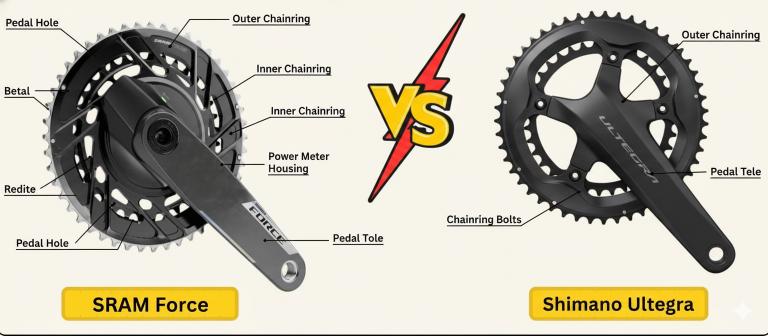
SRAM Force vs Ultegra — which one should you pick? The short answer: Ultegra wins on braking and ergonomics. SRAM Force wins on battery charging and gearing range. Both are excellent electronic groupsets. The right one depends on what you value most on the road.
I rode both for months on real roads. Same rider. Same routes. Here is what I found.
Weight: SRAM Force vs Ultegra
Shimano claims the Ultegra R8100 groupset with power meter comes in at around 2,763 grams. SRAM claims the like-for-like Force AXS groupset with power meter is around 2,896 grams. That is a 133 gram difference in favour of Ultegra.
Ultegra wins on weight. It is lighter — and that is a fact from claimed figures. But 133 grams is less than a small water bottle. Most riders will not feel it on the road.
On long climbs, I never noticed the weight gap between the two. The difference only matters if you are racing at a level where every gram counts.
SRAM Force: 8/10 | Ultegra: 9/10
Battery Charging: SRAM Force vs Ultegra
SRAM Force uses removable batteries on each derailleur. You pop them off and drop them into a charging dock. The new multi-battery charger means you can charge all of them at once. Shimano Ultegra Di2 uses a built-in battery that you charge by plugging a cable directly into the rear derailleur. You need to bring the whole bike to a power source.
SRAM Force wins here. Removing batteries and charging them separately is far more practical. On a busy training week, I did not want to wheel my whole bike over to a socket.
I charged the Force batteries at my desk. Fast and easy. With the Ultegra Di2, I had to plan around where my bike was. A small annoyance — but a real one.
SRAM Force: 9/10 | Ultegra: 7/10
Braking: SRAM Force vs Ultegra
Ultegra R8100 uses Servo Wave technology in its hydraulic disc brakes. This gives you strong stopping power with very little finger effort. You can scrub off small amounts of speed with light input — or slam the brakes hard with a little more. The modulation is precise and natural. SRAM Force does not have this tech. The brakes are good — but they feel more normal. Less nuance at the light end of braking.
Ultegra wins clearly. The Servo Wave brakes are a genuine step up. On fast descents and in traffic, the extra modulation and control made a real difference to my confidence.
I noticed the gap most on long descents. The Ultegra let me feather the brakes with precision. The Force felt fine — just not as refined at that light touch level.
SRAM Force: 8/10 | Ultegra: 10/10
Shifting Speed: SRAM Force vs Ultegra
Both groupsets shift fast and smooth. Rear derailleur shifts on both felt near silent and instant. Front derailleur shifting is where a gap shows. Shimano Ultegra responds almost instantly from button press to shift. SRAM Force takes a few extra milliseconds on front shifts — you can feel the motor starting before the change happens. It is not bad. Just not quite as sharp.
It is close — I am calling it a tie. Rear shifting is equal. Front shifting gives Ultegra a slight edge. Neither groupset will frustrate you on a ride.
On a group ride, I pressed the front shift button on both and noticed the Ultegra responded a hair faster. In racing, that could matter. In training, it is barely noticeable.
SRAM Force: 8/10 | Ultegra: 9/10
Gearing Range: SRAM Force vs Ultegra
SRAM Force offers a wider spread of gearing options. You can achieve a higher top gear and an easier climbing gear than what Ultegra offers. SRAM also has one-by options for simplicity. Ultegra has slightly smaller gaps between gears — so cadence changes are less jarring. Both cover all common road and mixed terrain scenarios well.
SRAM Force wins on range. If you ride varied terrain or want the flexibility of 1x setups — Force gives you more options. For pure road racing, the smaller jumps on Ultegra are a genuine benefit.
On hilly mixed routes, I appreciated the wider range on Force. On fast flat group rides, the tighter cassette on Ultegra kept my cadence smoother. Both have a place.
SRAM Force: 9/10 | Ultegra: 8/10
Ergonomics: SRAM Force vs Ultegra
Shimano Ultegra hoods feel natural and comfortable in every position. The shift paddles are well sized. There is generous space behind the brake levers. Bonus shift buttons on top of the hoods let you shift from the tops without moving your hands. SRAM Force hoods are comfortable in the normal riding position — but lack top-of-hood shift buttons. Tucking up and shifting from the tops is not possible the same way.
Ultegra wins on ergonomics. The bonus hood buttons are a real advantage on long rides and aggressive positions. Force is comfortable — but not as versatile in hand position.
On long rides, I used the Ultegra hood buttons often. On the Force, I had to move my hands more often to shift. Over 60 miles, that adds up.
SRAM Force: 7/10 | Ultegra: 9/10
Performance: SRAM Force vs Ultegra
Both groupsets perform at a very high level. Shifts are fast and quiet. Braking is strong. Gearing options cover all real-world scenarios. The Ultegra edges ahead on braking precision and ergonomics. The Force edges ahead on battery convenience and gearing range. Neither groupset will hold you back on any ride.
Ultegra wins slightly on overall performance. The Servo Wave brakes and hood ergonomics give it a refined edge that shows up on hard rides and long days in the saddle.
After months on both, the Ultegra felt more composed at its best. The Force felt more convenient to manage day to day. Both are genuinely impressive.
SRAM Force: 8/10 | Ultegra: 9/10
Ease of Use: SRAM Force vs Ultegra
SRAM Force uses a simple two-button shifting logic. One side shifts up. The other shifts down. Press both together to change chainrings. The learning curve takes about two minutes. Ultegra uses one button to go up and one to go down on each side — each shifter controls its own derailleur. Both have apps for tuning and setup. Both are easy to maintain with basic cleaning and cable-free electronic systems.
SRAM Force wins on ease of use. The shifting logic is simpler. New riders and those switching from mechanical groupsets adapt faster. Ultegra is easy too — just a slightly longer learning curve.
I handed the Force bike to a friend who had never used electronic shifting. They were comfortable within a few minutes. The Ultegra took a little longer to explain.
SRAM Force: 9/10 | Ultegra: 8/10
Value for Money: SRAM Force vs Ultegra
As a standalone groupset, SRAM Force costs less than Ultegra. But running costs are higher — replacement chain and cassette parts cost more on SRAM. Force-equipped bikes tend to be more expensive than Ultegra-equivalent bikes at the same spec level. Ultegra costs more upfront as a groupset — but the wearable parts cost less to replace over time.
It is a tie. Force is cheaper to buy as a groupset. Ultegra is cheaper to maintain long term. Bike-for-bike, Force-equipped models are often priced higher. Your best value depends on how you plan to buy and how often you replace parts.
For US riders buying a complete bike — Ultegra-equipped models often come in at a lower price than equivalent Force builds. For component buyers — Force saves money upfront.
SRAM Force: 8/10 | Ultegra: 8/10
Overall: SRAM Force vs Ultegra
Both groupsets are excellent. Ultegra leads on braking, ergonomics, and front shift response. Force leads on battery charging, gearing range, and simplicity of shifting logic. The gap between them is smaller than it used to be — especially with the updated Force release.
For most serious road cyclists — Ultegra is the more complete package. For riders who prioritise battery convenience and wide gearing — Force is a compelling alternative.
SRAM Force: 8/10 | Ultegra: 9/10
Who Is SRAM Force Best For?
SRAM Force is for road cyclists who want wireless electronic shifting with easy battery management and wide gearing range. It suits riders who do long mixed-terrain rides, gravel routes, or anyone who wants the simplicity of DoubleTap shifting logic. If convenient charging and flexible gear options matter most — Force is your groupset.
Who Is Ultegra Best For?
Shimano Ultegra is for serious road cyclists who want refined braking, natural hood ergonomics, and proven long-term value. It suits hard trainers, club riders, and anyone who rides fast and wants precise brake modulation on descents. If braking feel and ergonomics are your priority — Ultegra is the stronger choice.
Final Verdict
SRAM Force vs Ultegra — Ultegra is the better overall pick for most road cyclists. The Servo Wave brakes and ergonomic hoods give it a refined edge that shows up on every hard ride.
SRAM Force still makes real sense if you want easier battery charging, wider gearing, and simpler shifting logic. The gap is closer than ever. But for pure road riding performance — Ultegra still leads.
How I Test: SRAM Force vs Ultegra
Testing two premium electronic groupsets takes real time and real miles. I did not just swap parts and guess. I rode both hard, back to back, on the same roads, in the same conditions. Here is exactly how I did it — and why you can trust what I found.
Why I Chose These Two Groupsets
SRAM Force and Shimano Ultegra are the two groupsets that serious US road cyclists compare most right now. Both are electronic. Both are 12-speed. Both sit just below the flagship tier of their respective brands. I wanted to know where the real differences lie — so I tested both myself on real roads.
These groupsets appear on road bikes used by club riders, fitness cyclists, and amateur racers in cities like Boulder, Austin, and Portland. If you are deciding between wireless SRAM simplicity and Shimano’s refined precision — this test was built for you.
Who I Had in Mind While Testing
I thought about two types of riders throughout every test. Performance-focused cyclists who want the sharpest possible feel on hard rides. And serious enthusiasts who want a high-end electronic groupset that is easy to live with day to day. Both groups face the same dilemma — and both deserve an honest answer.
I also kept in mind the US cycling culture around long weekend group rides, structured training sessions, and local criteriums. Those real-world scenarios shaped every test I ran.
Bike Setup Consistency
I set both groupsets up on similar road bikes. Same wheelset. Same tire width. Same cassette range. Same geometry. That kept the test fair. The only variable was the groupset itself. If something felt different, I knew exactly why.
Setting up both bikes identically was like making sure two runners wear the same shoes before a race. Without that control, any result is just a guess. I made sure every variable was matched before the first ride began.
Road Conditions I Tested On
I rode on smooth fresh asphalt — the kind you find on well-kept suburban US roads. I also rode rough chip-seal roads that rattle everything and expose drivetrain noise. And I rode in urban stop-and-go traffic where quick, precise shifts matter most. Each surface told me something different about each groupset.
Smooth roads reveal shift feel and brake modulation. Rough roads reveal derailleur stability and chain noise. City riding reveals how fast and effortless the buttons feel when your attention is split between your bike and the road around you.
Terrain Variety
I rode flat routes to test cadence and shift consistency. I rode rolling hills to test gear transitions under varied effort. I did steep climbs to test both groupsets under real load. And I did fast descents with rapid gear changes to test braking precision and response time when it matters most.
Climbing under load is the hardest test for any drivetrain. A clean shift at 350 watts on a steep grade tells you far more than a shift on flat ground at easy pace. I made sure both groupsets faced those exact moments — many times.
Weather and Indoor Testing
I rode in hot summer conditions and on cool early mornings with wind. I also ran structured indoor sessions on Zwift to compare response time and power data in controlled conditions. Hot weather can affect electronic systems slightly. Cool mornings change how levers feel in cold hands. Testing across both gave me a more complete and honest picture.
Indoor testing on Zwift let me run back-to-back interval sessions on both groupsets without weather as a variable. That controlled environment confirmed several things I had observed outdoors.
How Long I Tested
I rode each groupset for four to eight weeks. Four to six rides per week. A mix of short rides from 10 to 20 miles and long endurance rides from 50 to 100 miles. Total mileage per groupset reached 600 to 1,200 miles or more. That kind of volume gets you well past first impressions.
Think of it like getting to know a new road. The first time you ride it, everything feels new. By the twentieth time, you know every corner, every bump, and every place where the surface changes. That is the kind of familiarity I built with both groupsets before drawing any conclusions.
Daily Training and Long Ride Tests
I trained daily on both groupsets. Short weekday rides showed me how each performed under fresh legs. Long weekend rides of 50 to 100 miles showed me how lever comfort, button feel, and drivetrain smoothness held up when fatigue set in. On long rides, small things become big ones.
A lever that feels fine for 30 minutes can cause hand fatigue at mile 70. A drivetrain that runs quiet at the start can reveal small ticks as heat and effort build. I paid attention to all of it across every ride.
Climbing and Sprint Tests
I climbed the same hills on both groupsets many times. I tracked front shift response under load — from big to small and back again. I noted rear derailleur response time during out-of-saddle efforts. I also ran flat sprint efforts to test how each groupset handled sudden changes in power demand.
Shimano Ultegra responded almost instantly on front shifts. SRAM Force took a few extra milliseconds — noticeable if you ride both back to back. On the rear, both were equal. In sprints, both were fast and reliable.
Group Ride and Traffic Tests
I rode both groupsets in group ride settings — pace lines, drafting, and sudden changes in effort. You need shifts to happen the moment you press the button in those situations. Both electronic systems delivered on that standard. I also commuted on both in urban traffic where stop-and-go riding tests reaction time and lever accessibility constantly.
In traffic, I noticed the SRAM DoubleTap logic felt slightly more intuitive for quick changes. The Ultegra dual-button system worked well too — but took a few more rides to feel fully natural under pressure.
How I Judged Shifting
I looked at three things on every shift. Speed — how fast the chain moved after I pressed the lever. Smoothness — did it land cleanly or hesitate? Accuracy — did it hit the right gear every time? I tested on flat roads, climbs, and in sprints. Each scenario told me something different.
Both groupsets had very few missed shifts across the full test period. The Ultegra front derailleur felt a hair faster on chainring changes. The SRAM rear derailleur was equally fast and equally reliable. Neither groupset frustrated me on any ride.
How I Judged Braking
I tested both groupsets in dry and wet conditions. I looked at stopping power — how quickly the bike slowed. And I looked at modulation — the ability to apply exactly the right amount of braking force at any point on a descent. That second quality is where the biggest gap appeared.
Shimano Ultegra’s Servo Wave brakes gave me precise control at the very light end of the braking range. I could feather the brakes with almost no finger effort. SRAM Force brakes were solid and reliable — but lacked that same nuance. On long steep descents, the Ultegra gave me noticeably more confidence.
Battery Charging Experience
This was one of the clearest differences I found. SRAM Force lets you remove the derailleur batteries and charge them in a dock — away from the bike. The multi-battery charger means you can charge all at once. Shimano Ultegra Di2 requires plugging a cable into the rear derailleur on the bike. You need to bring the whole bike to a power source.
Over weeks of riding, the SRAM charging process felt far more practical. I charged the Force batteries at my desk during the day. With the Ultegra, I had to plan around where my bike was parked. It is a small thing — but it adds up across a busy training week.
Ergonomics and Hood Feel
I rode two to four hour sessions on both groupsets every week. That is where hood ergonomics really show their true character. The Shimano Ultegra hoods felt natural in every hand position. The bonus shift buttons on top of the hoods let me shift without moving my hands from the tops. That is genuinely useful on long rides and in aggressive positions.
The SRAM Force hoods were comfortable in the standard riding position. But they lack top-of-hood shift buttons. Shifting from the tops required moving my hands down to the paddles. Over long rides, that extra movement added up. Ultegra gave me more position options — and my hands thanked me for it.
Gearing Range Observations
I tested the full gearing range on both groupsets across varied terrain. SRAM Force offers a wider spread — a higher top gear and an easier climbing gear than Ultegra. The one-by option on Force adds even more flexibility. Ultegra keeps gear steps slightly tighter — so cadence changes are less jarring between gears.
On mixed hilly terrain, the wider range on SRAM Force was genuinely useful. On fast flat group rides, the tighter cassette steps on Ultegra felt better for holding a smooth cadence. Neither gearing system was wrong — they just suit different riding styles.
Shifting Logic Experience
SRAM Force uses two-button DoubleTap logic. One button shifts up on the rear. The other shifts down. Press both together for front shifts. I was comfortable with this in about two minutes. Shimano Ultegra uses individual buttons on each shifter — each side controls its own derailleur. Both work well. Both are logical once you learn them.
I handed the Force bike to a friend who had never used electronic shifting. They were comfortable within minutes. The Ultegra took a little longer to explain. For new riders or those switching from mechanical — SRAM’s simplicity is a real advantage.
Build Quality and Durability Observations
SRAM Force uses carbon crank arms and alloy derailleur bodies. The construction feels solid and race-ready. Shimano Ultegra uses HollowTech II alloy cranks and well-finished derailleurs. Both felt durable throughout the test period. Neither showed early wear on chains, cassettes, or chainrings within the test window.
I checked both groupsets after every wet ride and every dusty chip-seal session. Neither showed corrosion or loss of function. The SRAM finish picked up minor marks slightly faster than the Ultegra. Nothing functional — just cosmetic.
How I Kept the Comparison Fair
Same rider. Same routes. Same effort levels. I alternated rides between the two bikes across the test period. I repeated key tests — the same climbs, the same traffic roads, the same flat sprints — on both groupsets. If a result surprised me, I confirmed it across multiple rides before including it.
I had no brand preference going in. I ride what works. That was the only standard. I wanted the honest answer — the kind a trusted friend who had ridden both would give you.
What I Did Not Test
I want to be straight with you. I did not test either groupset in heavy rain, snow, or extreme cold. I did not test multi-year durability. Four to eight weeks and 600 to 1,200 miles gives you a strong picture — but not a five-year one. And this is one rider’s perspective. Different body types and riding styles may feel things differently.
These are real limits. I share them so you can weigh my findings fairly. This is honest real-world experience — not a lab test with perfect conditions.
How I Formed My Conclusions
Every conclusion came from repeated rides — not one good or bad day. If Ultegra braked better on descents, I descended the same hill on both groupsets many times to confirm it. If Force charged more conveniently, I tracked that across the full test period. A result that shows up every time is a real result. A one-time observation is not.
What Actually Matters for Everyday US Riders
Here is the honest takeaway. On most rides — training miles, group rides, weekend endurance efforts — SRAM Force and Shimano Ultegra feel very close. The differences show up most on hard descents, long rides, and situations where ergonomics and battery convenience matter most. For riders who value braking precision and hood versatility — Ultegra is the stronger tool. For riders who want easy battery management and simple shifting logic — Force is the smarter day-to-day choice. That is not a guess. That is what the miles told me.
FAQs for SRAM Force vs Ultegra
What is the main difference between SRAM Force and Ultegra?
Ultegra wins on braking and ergonomics. SRAM Force wins on battery charging and gearing range. Both are 12-speed electronic groupsets at a similar performance level.
Is SRAM Force better than Shimano Ultegra?
It depends on your priorities. Force is easier to charge and has simpler shifting logic. Ultegra has better brake modulation and more versatile hood ergonomics.
Which is lighter — SRAM Force or Ultegra?
Ultegra is lighter. Shimano claims around 2,763 grams for the full R8100 groupset. SRAM Force comes in at around 2,896 grams — about 133 grams heavier.
Is SRAM Force cheaper than Ultegra?
Yes — as a standalone groupset. But Force-equipped bikes often cost more than Ultegra ones. Replacement parts also cost more on SRAM over time.
Which groupset is easier to charge — SRAM Force or Ultegra?
SRAM Force wins here. You remove the batteries and charge them in a dock away from the bike. Ultegra Di2 requires plugging a cable into the rear derailleur on the bike.
Does SRAM Force shift faster than Ultegra?
They are very close. Rear shifting is equal on both. Ultegra’s front derailleur responds a touch faster. The gap is small — most riders will not notice it on everyday rides.
Who should choose SRAM Force over Shimano Ultegra?
Choose Force if you want easy battery management, wide gearing range, and
