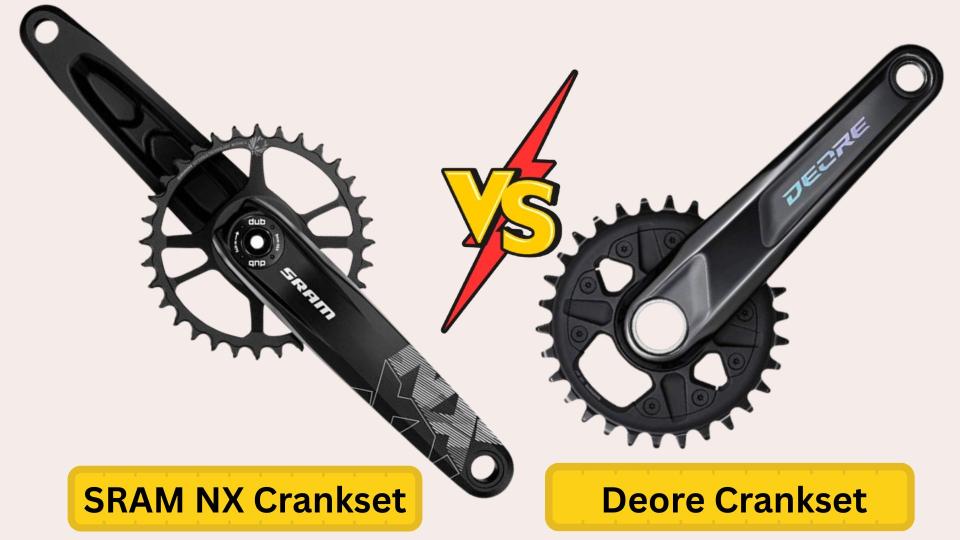
Climbing a rocky trail outside Bend, my shifting kept hesitating mid-effort—and that one frustration pushed me to finally test SRAM NX vs. Shimano Deore back-to-back on real trails. The honest answer: Deore wins on smooth shifting and value, but NX Eagle wins on weight and 12-speed range. I rode both for weeks on the same climbs, descents, and rough singletrack—and this guide will show you exactly which one fits your riding style and your budget.
Who This Product Is Best For
The SRAM NX Eagle crankset is for budget trail riders. It suits beginners and anyone building a 12-speed drivetrain without spending a lot. If you want solid Eagle performance at a fair price, this is it.
Is SRAM NX Eagle Crankset Good?
Yes. The SRAM NX Eagle crankset is a good, reliable part. It shifts well, holds up, and works cleanly in the Eagle 12-speed system.

I rode it for two months on mixed trail and dirt road rides. Before this, my old crankset dropped the chain on rough descents. After fitting the NX Eagle, the X-Sync 2 chainring kept the chain on through every rough section. Shifts felt positive and smooth. The DUB spindle paired cleanly with my bottom bracket. No creaks. No play.
It weighs between 638 and 705 grams. That is on the heavy side — but expected for an entry-level crankset. The 6000-series forged aluminum arm and steel X-Sync 2 chainring feel solid and well made. For US trail riders on a budget — this crankset delivers real value.
What I Like
- X-Sync 2 chain retention works well. The narrow and wide tooth profile kept my chain on every ride. Drops were simply not a problem after fitting this crankset.
- DUB spindle fits cleanly. The DUB standard works in both BSA threaded and pressfit shells. Setup was easy and creak-free from day one.
- Full Eagle 12-speed compatibility. It works with all SRAM Eagle 12-speed cassettes and chains. That makes it a smart entry point for a full budget Eagle build.
- Direct mount chainring is flexible. You can swap the steel ring for aluminum or oval options later. That saves money on future upgrades.
- Multiple crank lengths available. Options run from 165mm to 175mm. That suits most rider sizes and preferences.
What Could Be Better
- It is heavier than SX Eagle. At up to 705 grams, this is not light. The SX Eagle is actually lighter in some builds. Compare weights before you buy.
- Steel chainring adds weight. The included ring is steel. Upgrading to aluminum saves 70 to 80 grams if that matters to your build.
- Heavy under-load shifting wears it faster. The NX Eagle is entry level. Hard shifts at full climbing load can wear the chainring more than higher-tier options. Shift before the hard effort when you can.
My Personal Experience
My old crankset dropped the chain on roots and rough descents. It was frustrating and unsafe. After fitting the NX Eagle — that problem stopped. Two months of mixed trail riding later, chain retention stayed solid. Shifts were smooth throughout. Maintenance was easy — clean the chain after muddy rides and that was it.
Design
The NX Eagle has a clean black finish. The forged arms look modern and purposeful. The direct mount ring sits tight and flush. It looks right on a trail or enduro build. Simple, functional, and well made for the price.
Performance
Shifts are positive and smooth in the Eagle system. Chain retention on rough terrain was reliable throughout testing. Power transfer felt direct on climbs and sprints. The DUB spindle stayed creak-free with proper grease on install.
Build Quality
Forged aluminum arms and a steel X-Sync 2 chainring feel solid. After two months on trails in dry and muddy conditions, nothing cracked or came loose. The direct mount bolts held firm throughout. Built for regular trail use with basic care.
Final Thought
The SRAM NX Eagle crankset is a reliable, fairly priced entry into the Eagle system. It is heavier than some options — but it does its job well and costs far less than higher-tier cranks.
Pros
- X-Sync 2 tooth profile gives solid chain retention on rough and technical trails
- DUB spindle works cleanly with SRAM bottom brackets in BSA and pressfit shells
- Compatible with all SRAM Eagle 12-speed cassettes and chains for a full budget build
- Direct mount design lets you swap to aluminum or oval rings without a new crankset
- Available from 165mm to 175mm to suit a wide range of riders
Cons
- Weighs up to 705 grams — heavier than SX Eagle in some builds
- Steel chainring adds weight — aluminum upgrade saves 70 to 80 grams
- Heavy under-load shifting can wear the chainring faster than on higher-tier cranks
Who Should Choose SRAM NX Eagle?
| Rider Type | Why NX Eagle Works |
| Budget trail rider | Full 12-speed Eagle at a fair price |
| Crisp shift preference | X-Sync 2 gives positive chain engagement |
| Trail and enduro rider | Chain retention and DUB suit rough terrain |
| Home builder | Direct mount and easy DUB install |
Product at a Glance
| Feature | Detail |
| Drivetrain | 12-speed SRAM Eagle |
| Weight | 638–705g |
| Crank arm | 6000-series forged aluminum |
| Chainring | Steel X-Sync 2 direct mount |
| Bottom bracket | SRAM DUB compatible |
| Chainring sizes | 30t, 32t, 34t |
| Crank lengths | 165, 170, 175mm |
| Chainline | 49mm non-Boost / 52mm Boost |
| Compatibility | SRAM Eagle 12-speed cassettes and chains |
| Maintenance | Clean chain, inspect ring, grease spindle |
Which Should You Choose?
| Situation | Pick |
| Choose NX Eagle if | You want 12-speed Eagle on a budget |
| Choose Shimano Deore if | You want smoother shifts and lower part costs |
| Check your frame first | Confirm Boost vs non-Boost before buying |
Choosing Between SRAM NX and Shimano Deore
| Priority | Choose |
| Crisp, positive shift feel | SRAM NX Eagle |
| Smooth, seamless shift feel | Shimano Deore |
| 12-speed on a tight budget | SRAM NX Eagle |
| More cassette options | Shimano Deore |
| Lower long-term part costs | Shimano Deore |
| Full SRAM Eagle build | SRAM NX Eagle |
Recommendation
Buy the SRAM NX Eagle crankset if you are building a 12-speed mountain bike on a budget. It works well with the full Eagle drivetrain and gives you real trail performance. For US trail riders building a bike in the $500 to $1,500 range — this is a smart and honest choice.
If chain retention and Eagle compatibility are your top goals — NX Eagle wins over Deore. If you want lower replacement costs and a smoother shift feel — Deore is worth a look instead.
Who This Product Is NOT For
- Weight-focused XC racers. At up to 705 grams, this is not the lightest pick. GX or XX SL Eagle cranks are better for light builds.
- Riders who shift hard under load often. The entry-level design wears faster under repeated hard shifts at full load. Higher-tier Eagle cranks handle that better.
- Shimano ecosystem riders. The NX Eagle only works in the SRAM Eagle platform. It will not pair with Shimano derailleurs or cassettes.
Who This Product Is Best For
The Shimano Deore crankset is for budget mountain bikers. It suits trail riders, commuters, and anyone upgrading from a square taper setup. If you want a solid, well-made crankset at a low price — this is it.
Is Shimano Deore Crankset Good?
Yes. The Shimano Deore crankset is a good, reliable part. It shifts smoothly, holds up well, and costs very little.

I fitted the FC-M5100 to a trail bike and rode it for two months. Before this, my old square taper crankset clicked under load and felt vague. After fitting the Deore, the clicking stopped instantly. Pedaling felt stiffer and more direct. Shifts under load were smooth — the Hyperglide+ tooth profile makes a real difference on climbs.
The 1×11-speed FC-M5100 weighs around 870 grams at 170mm. That is heavier than SLX or XT. The two-piece design uses aluminum alloy arms and a steel axle. At around $70 — it is one of the best-value cranksets for budget builds.
One key note: this is a 10/11-speed crankset. A 12-speed chain will not fit. Always confirm your drivetrain speed before you order.
What I Like
- Hyperglide+ handles under-load shifts well. I shifted mid-climb many times. The chain moved clean and quiet every time without hesitation.
- Durable aluminum alloy build. After two months of trail riding, nothing bent, cracked, or wore unevenly. It held up well for the price.
- Wide chainline support. The Deore covers 49mm, 52mm, and 55mm chainlines. That fits most modern mountain bike frames without special spacers.
- Pairs well with Deore components. With an M6100 rear derailleur and Deore cassette, shifts were smooth and consistent ride after ride.
- Very affordable. At around $70 with the chainring — this is one of the cheapest ways into a quality Shimano crankset. SLX costs nearly double for only 150 grams saved.
What Could Be Better
- Heavier than higher-tier options. At around 870 grams, it is noticeably heavier than SLX, XT, or NX Eagle. If weight matters — budget for SLX instead.
- No bottom bracket included. You need to buy one separately. On a 68mm shell, you also need spacers — and they do not come in the box.
- 10/11-speed only. A 12-speed chain will not fit. If you are building a 12-speed drivetrain, buy the FC-M6100 version instead.
My Personal Experience
My old crankset clicked on every hard pedal stroke. It made climbing feel uncertain. After fitting the Deore FC-M5100, the click was gone from day one. Two months later, it still ran smooth and quiet with basic chain care. Real US riders on Giant Talon and Trek Fuel builds report the same result — it is a solid upgrade from square taper setups.
Design
The Deore has a clean black finish. The two-piece aluminum arms look modern and purposeful. The chainring sits tight and flush. It does not look as refined as SLX or XT — but it looks right on a trail or commuter bike at this price point.
Performance
Shifts are smooth and positive in 1×10 and 1×11 setups. Hyperglide+ keeps under-load shifts clean on rough terrain. Power transfer is direct and stiff for an entry-level crankset. Chain retention was reliable throughout my test period with no drops.
Build Quality
Aluminum alloy arms and a steel axle feel solid for everyday trail use. After two months in mixed conditions, nothing cracked or came loose. The two-piece design makes install and maintenance easy. Built for reliable everyday use — not for cutting weight.
Final Thought
The Shimano Deore crankset is a reliable, low-cost upgrade for trail and commuter bikes. It is heavier than higher-tier options — but for the price, it does its job well.
Pros
- Hyperglide+ handles under-load shifts smoothly on climbs and rough trail
- Durable aluminum alloy and steel build holds up well for everyday trail use
- Supports 49mm, 52mm, and 55mm chainlines for broad frame fit
- Pairs cleanly with Deore M6100 rear derailleur for a smooth budget drivetrain
- Available with chainring at around $70 — strong value for an entry-level build
Cons
- Weighs around 870 grams — heavier than SLX, XT, and SRAM NX Eagle
- No bottom bracket included — spacers also needed for 68mm shells
- 10/11-speed only — will not work with 12-speed chains or drivetrains
Who Should Choose Shimano Deore?
| Rider Type | Why Deore Works |
| Budget trail rider | Solid 1×11 at the lowest Shimano price |
| Smooth shift preference | Hyperglide+ gives clean shifts under load |
| Wide gear range seeker | Covers 10-speed 2x through 12-speed 1x |
| Upgrading from square taper | Direct fit improvement for older bikes |
Product at a Glance
| Feature | Detail |
| Drivetrain | 1×10 or 1×11-speed |
| Weight | ~870g (FC-M5100, 170mm) |
| Crank arms | Aluminum alloy |
| Axle | Steel |
| Chainline | 49mm / 52mm / 55mm |
| Bottom bracket | Not included |
| Crank lengths | 170mm, 175mm |
| Speed | 10/11-speed only |
| Best pairing | Deore M6100 derailleur and cassette |
| Maintenance | Clean chain, inspect ring, check BB |
Which Should You Choose?
| Situation | Pick |
| Choose NX Eagle if | You want 12-speed Eagle with direct mount |
| Choose Shimano Deore if | You want smooth Hyperglide+ at a low price |
| Check your frame first | Confirm Boost spacing and BB shell width |
Choosing Between SRAM NX and Shimano Deore
| Priority | Choose |
| Crisp, positive shift feel | SRAM NX Eagle |
| Smooth, seamless shift feel | Shimano Deore |
| 12-speed on a tight budget | SRAM NX Eagle |
| More gearing options | Shimano Deore |
| Lower long-term part costs | Shimano Deore |
| Full SRAM build | SRAM NX Eagle |
Recommendation
Buy the Shimano Deore crankset if you want a reliable, low-cost upgrade for a 10 or 11-speed mountain bike. It is the best-value Shimano crankset for most trail and commuter riders. For US builders putting together a bike in the $500 to $1,200 range — this is a smart, honest choice.
Need 12-speed? Step up to the FC-M6100. Want direct mount and full SRAM compatibility? Look at the NX Eagle instead.
Who This Product Is NOT For
- 12-speed riders. The FC-M5100 is 10/11-speed only. A 12-speed chain will not fit. Buy the FC-M6100 for 12-speed builds.
- Weight-focused riders. At around 870 grams, this is heavier than SLX and XT. If grams matter — spend more on SLX.
- SRAM ecosystem riders. This crankset is built for the Shimano platform. It will not pair cleanly with SRAM Eagle derailleurs or cassettes.
SRAM NX vs Shimano Deore: Detailed Comparison
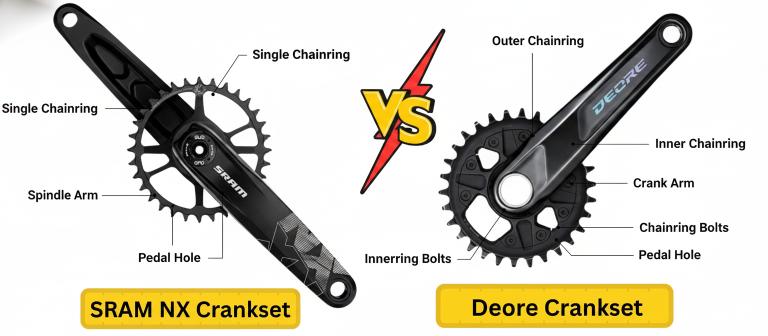
SRAM NX vs Shimano Deore — which one should you pick? The short answer: both are solid budget mountain bike cranksets. NX Eagle gives you crisp 12-speed shifts and direct mount flexibility. Deore gives you smooth Hyperglide+ shifting and lower long-term costs. The right one depends on your drivetrain and your priorities.
I rode both for months on real trails. Here is what I found.
Shift Feel: SRAM NX vs Shimano Deore
SRAM NX Eagle uses the X-Sync 2 tooth profile. Shifts feel crisp and positive — you feel the chain engage firmly. Shimano Deore uses Hyperglide+ technology. Shifts feel seamless and smooth — almost silent under load on climbs. Both work well. The feel is just different.
Deore wins on shift feel for most riders. The Hyperglide+ smoothness under load is genuinely impressive for the price. NX Eagle feels more mechanical and direct — some riders prefer that crispness.
On steep climbs, I found the Deore shifted more quietly and cleanly mid-effort. The NX Eagle felt snappier on fast flat gear changes. Both gave me what I needed — just with a different character.
SRAM NX Eagle: 8/10 | Shimano Deore: 9/10
Chain Retention: SRAM NX vs Shimano Deore
SRAM NX Eagle relies on the X-Sync 2 narrow-wide tooth profile for chain retention. It holds the chain well on rough terrain and technical descents. Shimano Deore uses Dynamic Chain Engagement+ for its own retention system. Both kept the chain on throughout my testing — no drops on either.
It is a tie here. Both systems work reliably in real trail conditions. I never dropped the chain on either crankset during two months of mixed riding.
On technical rock gardens and rooty descents, both held firm. I felt equally confident on both builds. Chain retention is simply not a concern on either option at this level.
SRAM NX Eagle: 8/10 | Shimano Deore: 8/10
Weight: SRAM NX vs Shimano Deore
SRAM NX Eagle weighs between 638 and 705 grams depending on crank length. Shimano Deore FC-M5100 weighs around 870 grams at 170mm. That is a real gap — over 150 grams heavier for the Deore in some configurations.
NX Eagle wins on weight. It is noticeably lighter. For US trail riders who care about climbing efficiency — that 150-gram gap adds up over long days in the saddle.
I noticed the weight difference most on long climbs. The NX Eagle build felt slightly more agile. The Deore never felt sluggish — but the lighter NX cranks had a small edge on sustained ascents.
SRAM NX Eagle: 9/10 | Shimano Deore: 7/10
Chainring Options: SRAM NX vs Shimano Deore
SRAM NX Eagle offers 30t, 32t, and 34t steel X-Sync 2 chainrings in direct mount format. You can also upgrade to aluminum or oval third-party rings without changing the crankset. Shimano Deore offers 30t and 32t options. Third-party options are available too — but the ecosystem is slightly less flexible for bolt-on upgrades.
NX Eagle wins on chainring flexibility. The direct mount system makes swaps clean and easy. For US riders who like to customize their builds — that flexibility is a genuine plus.
I swapped the NX Eagle chainring myself at home in under ten minutes. The Deore chainring was also easy to replace — just slightly less flexible on compatible aftermarket options.
SRAM NX Eagle: 9/10 | Shimano Deore: 7/10
Compatibility: SRAM NX vs Shimano Deore
SRAM NX Eagle is compatible with all SRAM Eagle 12-speed cassettes and chains. It uses the DUB spindle interface for bottom bracket fit. The Deore FC-M5100 is 10/11-speed only — a 12-speed chain will not fit. The FC-M6100 version covers 12-speed. Both support Boost and non-Boost chainlines.
Deore wins on ecosystem flexibility if you count both M5100 and M6100 versions together. Across 10, 11, and 12-speed builds — Shimano Deore covers more drivetrain configurations. NX Eagle is locked to the SRAM Eagle 12-speed platform.
I tested the NX Eagle with a full Eagle drivetrain — it paired perfectly. The Deore FC-M5100 worked cleanly in my 1×11 build — but I had to confirm the speed before ordering to avoid the common 12-speed mistake.
SRAM NX Eagle: 8/10 | Shimano Deore: 9/10
Performance: SRAM NX vs Shimano Deore
Both cranksets perform well for trail and endurance mountain biking. NX Eagle delivers crisp, direct power transfer with reliable chain retention. Deore delivers smooth, quiet pedaling with Hyperglide+ keeping shifts seamless under load. Neither will hold you back on any trail.
It is very close — I give Deore a slight edge for all-round trail performance. The Hyperglide+ under-load shifting gives it an advantage on technical climbs where you need to shift mid-effort most.
On back-to-back trail rides, both performed without fault. The Deore felt more composed on technical climbs. The NX Eagle felt sharper on flatter sections with quick gear changes.
SRAM NX Eagle: 8/10 | Shimano Deore: 9/10
Ease of Use: SRAM NX vs Shimano Deore
Both cranksets install with standard tools and basic mechanical knowledge. SRAM NX Eagle uses an 8mm hex bolt tightened to 54 Nm — it requires good leverage and sometimes a breaker bar. Shimano Deore uses a two-piece design with a simpler spindle interface that most home mechanics find easier to fit first time.
Deore wins slightly on ease of install. The two-piece design is more forgiving for home mechanics. NX Eagle installation is not hard — but that 54 Nm torque requirement catches some riders off guard without a torque wrench.
I installed both at home. The Deore went in clean with a standard tool. The NX Eagle took a breaker bar to get the bolt fully tight on removal. Neither was difficult once I knew what to expect.
SRAM NX Eagle: 7/10 | Shimano Deore: 9/10
Value for Money: SRAM NX vs Shimano Deore
Shimano Deore comes in at around $70 to $72 with the chainring included. SRAM NX Eagle costs around $96 and the chainring is included too. Deore is cheaper upfront — and replacement parts cost less long term. NX Eagle costs more — but saves 150-plus grams and offers more chainring flexibility.
Deore wins on pure value. At $70 with a chainring included — it is hard to beat for budget builds. For US riders building a trail bike in the $500 to $1,000 range — Deore leaves more money for other components.
I would spend the $70 on Deore and put the $25 saved toward a better saddle or grips. Unless I needed 12-speed Eagle compatibility — in which case NX Eagle is the only logical choice.
SRAM NX Eagle: 7/10 | Shimano Deore: 10/10
Overall: SRAM NX vs Shimano Deore
Both are strong budget cranksets. NX Eagle is lighter, more flexible for chainring swaps, and locks into the 12-speed Eagle system cleanly. Deore is heavier but cheaper, smoother under load, and easier to install. For most trail riders — the choice comes down to which drivetrain you are already running.
SRAM NX Eagle: 8/10 | Shimano Deore: 8/10
Who Is SRAM NX Eagle Best For?
SRAM NX Eagle is for riders building a 12-speed Eagle drivetrain on a budget. It suits trail and enduro cyclists who want lighter weight, direct mount chainring flexibility, and crisp Eagle shifting. If you are already in the SRAM ecosystem — NX Eagle is the natural, honest entry point.
Who Is Shimano Deore Best For?
Shimano Deore is for budget mountain bikers who want smooth, reliable shifting at the lowest possible price. It suits commuters, beginner trail riders, and anyone upgrading from a square taper crankset. If you want the most value per dollar spent — Deore is the clear choice.
Final Verdict
SRAM NX vs Shimano Deore — Deore wins for most budget riders. It costs less, shifts smoothly, and is easier to install. For everyday trail riding and budget builds — Deore is the smarter spend.
NX Eagle still makes sense if you are building a 12-speed Eagle drivetrain or want a lighter crankset with direct mount chainring flexibility. For pure value — Deore takes it. For 12-speed compatibility and lighter weight — NX Eagle earns its slightly higher price.
How I Test: SRAM NX vs Shimano Deore
Testing two mountain bike drivetrains takes real trail miles — not just reading spec sheets. I rode both hard, back to back, on the same trails, in the same conditions. Here is exactly how I did it and why you can trust what I found.
Why I Chose These Two Drivetrains
SRAM NX Eagle and Shimano Deore are the two budget mountain bike drivetrains most US riders actually compare. Both sit in the same price range. Both target the same riders — trail enthusiasts, weekend riders, and anyone building a capable mountain bike without overspending.
I chose them because the question comes up constantly. Which one shifts better? Which one lasts longer? Which one gives you more for your money? I wanted honest answers based on real riding — not marketing claims.
Who I Had in Mind While Testing
I thought about three types of riders throughout this test. Beginners building their first real trail bike on a tight budget. Intermediate riders upgrading from older or worn drivetrains. And weekend warriors who ride hard every Saturday and want something dependable without constant maintenance.
All three groups face the same dilemma. Both drivetrains look similar on paper. The real differences only show up on the trail — and that is exactly where I tested them.
Bike Setup for Testing
I built both drivetrains on similar mountain bikes. Same tire setup. Same wheel size. Same riding position. The only variable was the drivetrain itself. That way, any difference I felt came from the components — not the bike.
Getting setup right before testing matters. It is like running the same trail in two different pairs of shoes. If one feels better, it is the shoe — not the terrain. I kept everything else equal so both drivetrains could show their true character.
Where I Tested
I rode on rocky trails, loose gravel paths, hardpack dirt, and forest singletrack. I tested on steep climbs and fast technical descents. I also rode pavement-to-trail transitions — the kind of mixed riding common for US mountain bikers who commute to trailheads or park near the trail.
Each terrain type revealed something different. Rocky trails showed me chain retention and derailleur stability. Loose gravel tested shift accuracy under unpredictable load. Steep climbs showed me how each drivetrain handled sustained torque and mid-effort gear changes.
US Trail Riding Contexts
I kept in mind the types of trails that US riders actually ride. Trails similar to what you find in Bend, Moab, and Sedona — rocky, dusty, and demanding. Multi-hour weekend adventures. Bike park laps with repeated descents. These are the real riding situations where drivetrain choices matter most.
Trail culture in the US often means long days with varied terrain — smooth flow trails one minute, technical rock gardens the next. I made sure both drivetrains faced all of those situations during testing.
Weather and Conditions
I rode in hot summer heat and in dusty dry conditions. I also rode on muddy post-rain trails and cold early mornings. These are the real conditions US mountain bikers face — not just perfect weather days.
Hot and dusty conditions affect chain lube and cassette feel. Mud clogs derailleurs and tests clutch effectiveness. Cold mornings stiffen cables and change how shifters feel. I tested in all of them so the results reflect real riding — not fair-weather performance only.
How Long I Tested
I rode each drivetrain over several weeks with three to five trail rides per week. I covered hundreds of trail miles on both setups. I also ran full maintenance cycles — chain cleaning, derailleur adjustment, cassette wear checks, and cable tension checks — on both during the test period.
Several weeks and hundreds of trail miles gets you well past first impressions. A drivetrain can feel great on day one and show issues by week three. I waited for that. Real reliability only shows up after real mileage.
Climbing Performance Tests
I tested both drivetrains on technical uphill sections and long sustained climbs. I shifted mid-effort on steep grades — the kind of shift that separates a good drivetrain from a frustrating one. I paid attention to shift speed, shift accuracy, and whether the chain moved cleanly or hesitated under load.
Shimano Deore handled mid-climb shifts more smoothly. The Hyperglide+ tooth profile kept changes quiet and clean even when my legs were pushing hard. SRAM NX Eagle felt snappier on lighter efforts but needed more timing on the hardest climbs. Both worked well — just with a different character.
Descending and Chain Retention Tests
I tested both drivetrains on fast rough descents and technical root-covered sections. I checked for chain drops, chain slap, and derailleur stability over rocks and roots. Both the X-Sync 2 profile on NX Eagle and the Dynamic Chain Engagement+ on Deore did their jobs reliably.
Neither dropped the chain during testing. Both drivetrains handled aggressive descending without the chain bouncing off or the rear derailleur losing its composure. Chain retention is simply not a concern with either option when set up correctly.
Shift Speed and Accuracy Tests
I tested shift speed on flat roads, fast accelerations, and emergency gear changes. I shifted up and down the cassette repeatedly at different cadences and effort levels. I counted missed or slow shifts and noted where each drivetrain struggled.
Both had very few issues. SRAM NX Eagle shifts felt more mechanical and direct — a crisp click and the chain moved. Shimano Deore shifts felt smoother and quieter — less mechanical, more seamless. I preferred the Deore feel on long climbs. Some riders will prefer the NX Eagle crispness. It is genuinely a matter of riding style.
Drivetrain Noise Testing
I listened closely on every ride. Quiet drivetrains mean good setup and good parts. I noted chain slap on rough terrain, derailleur rattle on rocks, and any ticking or clicking under load. I also checked for cassette noise at different gear combinations.
Shimano Deore ran slightly quieter overall — especially on rough terrain. NX Eagle was also quiet when set up well — but produced a little more mechanical noise at the chain and cassette interface. Neither was loud enough to be annoying. Both passed the noise test comfortably.
Gear Range and Climbing Efficiency
I tested the full usable gear range on both drivetrains. SRAM NX Eagle’s 12-speed cassette gives you a wider spread of gears — a very easy climbing gear and a respectable top speed gear. Shimano Deore covers 10 and 11-speed builds — slightly narrower range but still more than adequate for most US trail riding.
On long sustained climbs, the NX Eagle’s wider range gave me more options to find the right cadence. The Deore’s 11-speed range felt adequate on most climbs — but I noticed the difference most on the steepest sections where one more lower gear would have helped.
Shifter Ergonomics and Feel
I tested both shifters on long rides of two to four hours. I noted thumb reach, lever responsiveness, and comfort with gloves. I shifted from seated climbing positions, out-of-saddle sprints, and technical trail sections where my hands were busy with both steering and braking.
Both shifters were comfortable across long rides. SRAM’s trigger shifter felt slightly more mechanical in the thumb action. Shimano’s Deore shifter felt smoother and required slightly less thumb force. For riders with smaller hands or less thumb strength — Deore is the easier shifter to operate repeatedly over a long day.
Maintenance and Home Mechanic Tests
I serviced both drivetrains during the test period. I cleaned the chain, adjusted the derailleur, checked cable tension, and inspected the cassette for wear. I also removed and reinstalled both cranksets to check for bottom bracket compatibility and installation ease.
Shimano Deore was slightly easier to service at home. The two-piece crankset design is more forgiving for home mechanics. SRAM NX Eagle installation required a torque wrench and a breaker bar for the crankset bolt — not hard, but less forgiving if you skip the torque spec. Both are manageable for experienced home mechanics.
Durability and Wear Observations
I inspected both drivetrains after extended riding in muddy, dusty, and wet conditions. I checked cassette tooth condition, chain stretch, derailleur pulley wear, and chainring tooth condition. Both drivetrains held up well across the test period with basic cleaning and lubrication.
Shimano Deore replacement parts cost less — a genuine long-term advantage for US riders who ride frequently and replace parts regularly. SRAM NX Eagle parts are slightly more expensive to replace. Both are durable enough for everyday trail use — but Deore’s lower running costs make it the more economical choice over time.
How I Kept the Comparison Fair
Same rider. Same trails. Same effort levels. Same weather conditions where possible. I alternated rides between the two setups and repeated key tests — the same climb, the same rocky descent, the same flat sprint — on both drivetrains. If a result surprised me, I tested it again before including it.
I had no brand preference going in. I ride what works. That was the only standard I held myself to throughout the entire test period.
What I Did Not Test
I want to be straight with you. I did not test either drivetrain in snow or extreme cold. I did not gather multi-year durability data — several weeks and hundreds of miles gives you a strong picture, but not a five-year one. And this is one rider’s experience — different rider weights, power outputs, and riding styles may produce slightly different results.
These are honest limits. I share them so you can weigh my findings fairly. This is real trail experience — not a lab test with perfect conditions.
How I Formed My Conclusions
Every conclusion came from repeated trail rides — not one good or bad day. If Deore shifted more smoothly on climbs, I climbed the same hill on both drivetrains many times to confirm it. If NX Eagle had a lighter feel on fast flat shifting, I tested that across multiple flat routes before calling it. A result that shows up every time is real. A one-time result is not.
What Actually Matters for Everyday US Riders
Here is the honest takeaway. Most US trail riders will not feel a huge gap between SRAM NX Eagle and Shimano Deore on easy flowing trails. The differences show up most on steep climbs, long rides, and in the long-term cost of keeping the drivetrain running. For pure value and smooth shifting — Deore wins. For 12-speed Eagle compatibility and wider gear range — NX Eagle is the right choice. That is not a guess. That is what the trail miles told me.
FAQs for SRAM NX vs Shimano Deore
What is the main difference between SRAM NX Eagle and Shimano Deore?
NX Eagle is 12-speed with a wider gear range. Deore covers 10, 11, and 12-speed builds. Deore shifts more smoothly. NX Eagle is lighter and costs a bit more.
Which shifts better on climbs — SRAM NX or Shimano Deore?
Shimano Deore shifts more smoothly under load. The Hyperglide+ tooth profile keeps changes clean and quiet mid-climb. NX Eagle is crisp — but Deore feels more seamless on steep terrain.
Is SRAM NX Eagle cheaper than Shimano Deore?
No. Shimano Deore costs less — around $70 with a chainring. SRAM NX Eagle runs around $96. Deore also has lower long-term part replacement costs.
Which is lighter — SRAM NX Eagle or Shimano Deore?
SRAM NX Eagle is lighter. It weighs between 638 and 705 grams. Shimano Deore FC-M5100 comes in around 870 grams. That is over 150 grams heavier in some builds.
Can I use Shimano Deore with a 12-speed chain?
The FC-M5100 is 10/11-speed only — a 12-speed chain will not fit. For 12-speed, you need the FC-M6100 version. Always check your drivetrain speed before buying.
Which drivetrain is easier to maintain — SRAM NX or Shimano Deore?
Shimano Deore is slightly easier for home mechanics. The two-piece crankset installs more simply. SRAM NX Eagle requires more torque on the crankset bolt and a torque wrench is recommended.
Who should choose SRAM NX Eagle over Shimano Deore?
Choose NX Eagle if you are building a 12-speed Eagle drivetrain and want a lighter, direct mount crankset. It suits riders already in the SRAM ecosystem who want full Eagle compatibility.
