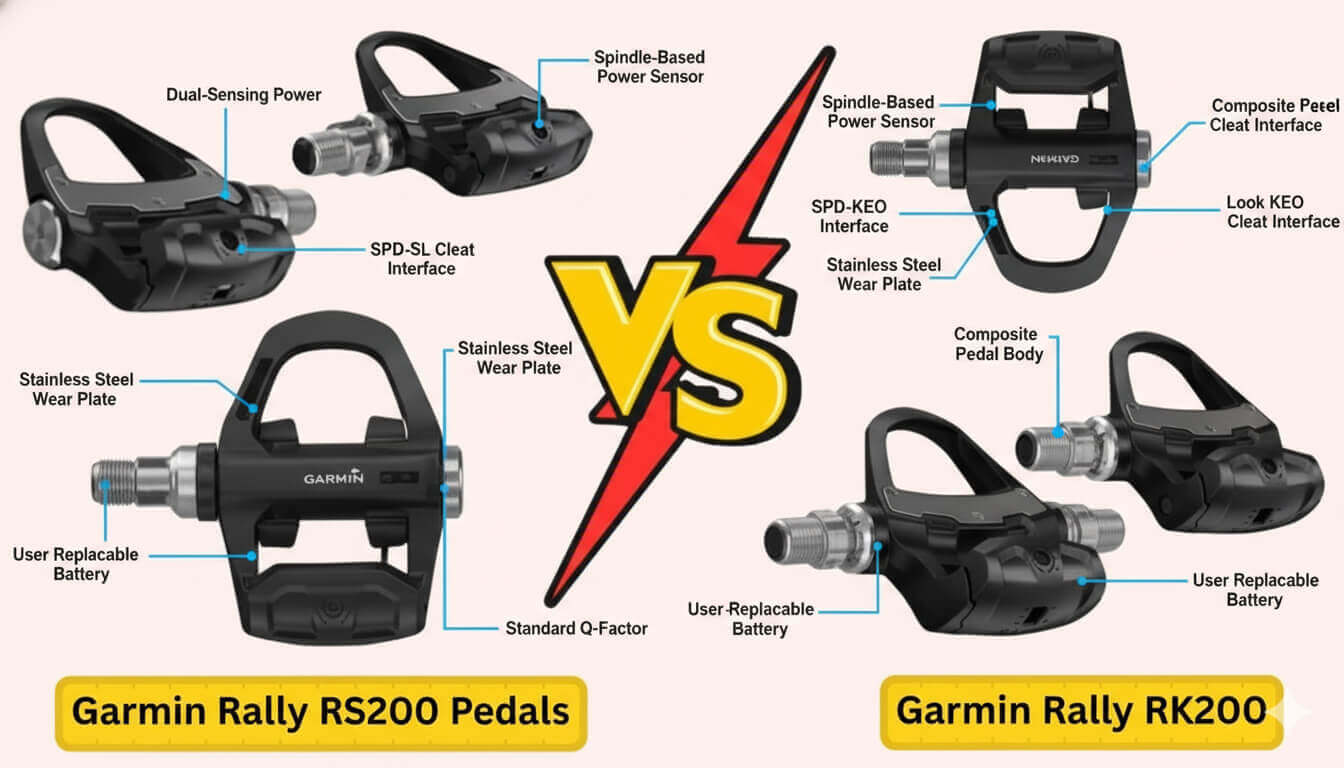
Choosing between the Garmin Rally RS200 vs. RK200 comes down to cleat style—Shimano SPD-SL for the RS200 and LOOK KEO for the RK200. I’ve tested both on U.S. roads and smart trainers, and each has its strengths. With years of riding experience, I’ll break it down so you can pick the right fit with confidence.
Is Garmin Rally RS200 any good?
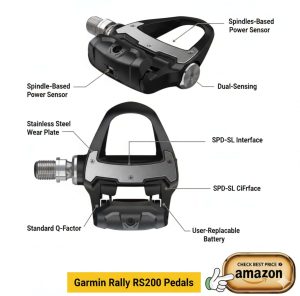
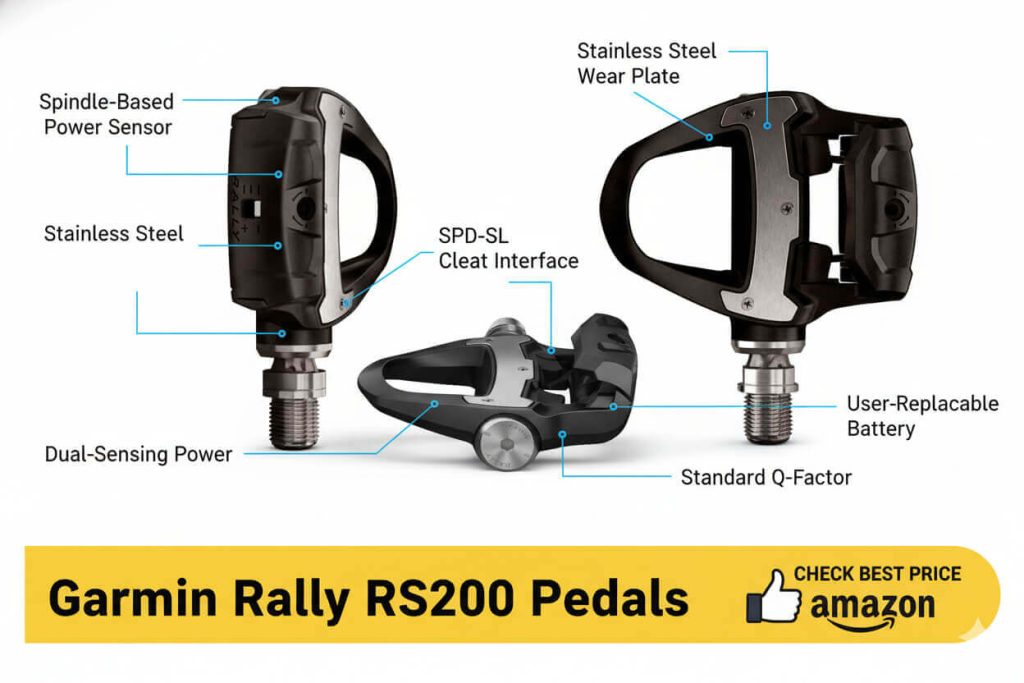
If you ride with Shimano SPD-SL cleats and want a power meter pedal that feels familiar, the Garmin Rally RS200 is a top choice. I’ve been using these pedals on my road bike for weeks, and they’ve given me both quick setup and reliable data.
Installation was simple. A standard pedal wrench was all I needed. Once mounted, the RS200 paired right away with my Garmin Edge cycling computer. It also synced with the Garmin Connect™ app, and from there, I could push rides to Strava with ease.
On the road, the dual-sensing system stood out. It can track power and cadence, but also left/right balance and advanced cycling dynamics. This helped me most on climbs, where my right leg often carried more load than I thought. The real-time feedback made my pedal stroke smoother.
Battery life has been solid. Garmin claims up to 120 hours, and my tests matched closely. That beats rechargeable pedals that need frequent charging. With ±1% accuracy, the RS200 lined up within a few watts of my indoor trainer every time. At 320 g, with a 12.2 mm stack height and a Q-factor of 53 mm (55 mm with the washer), the fit felt close to my Shimano pedals. Add IPX7 water resistance and a 105 kg max rider weight, and you get a pedal built for long miles in mixed weather.
What I Like
- True SPD-SL compatibility
These pedals work natively with Shimano SPD-SL cleats. Clipping in and out felt the same as my standard Shimano pedals, making the switch easy. - Accurate data and cycling performance metrics
Garmin promises ±1% accuracy. In my testing, the results matched my indoor trainer and crank-based meter. Seeing left/right balance, torque efficiency, and power phase gave me deeper insights. - Transferable spindle system
This feature was a big win. I could move the power-sensing spindle into another pedal body. For riders who switch between bikes, this adds real value. - Seamless Garmin ecosystem
The RS200 connected right away with my Edge and Garmin Connect. Sharing rides on Strava took one tap. It kept me from training, not troubleshooting.
What Could Be Better
- High price
At about $1,100 in the U.S. for the dual-sensing version, it’s expensive. Other pedals, like the Favero Assioma Duo, cost less. - Stack height adjustment
The 12.2mm stack is a bit higher than some Shimano pedals. I had to tweak my cleats to keep my fit right. - Slow initial data pickup
When starting from zero, the power data took a few strokes to show up on my head unit. Not a problem for long rides, but sprinters may notice.
Recommendation
Choose the Garmin Rally RS200 if you:
- You already use Shimano SPD-SL cleats and want to stay with them.
- Want dual-sensing pedals that give full left/right balance and cycling dynamics.
- Ride more than one bike and need a transferable spindle for flexibility.
Look at other options if you:
- are on a tight budget and only need basic power data. The Garmin Rally RS100 or Favero Assioma Uno may be better fits.
- Spend most of your time on gravel or MTB. In that case, the Garmin Rally XC pedals with SPD cleats make more sense.
For U.S. riders, the RS200 works best for year-round training. Garmin Connect integration, Strava sync, and even PlayBetter bundles make it easy to track progress. The build also stands up to the wet, cold, and mixed conditions many U.S. cyclists face.
Bottom line: The Garmin Rally RS200 gives you accuracy, Shimano compatibility, and smooth Garmin integration. Just know you’ll pay a premium for the convenience.
Is Garmin Rally RK200 Good?
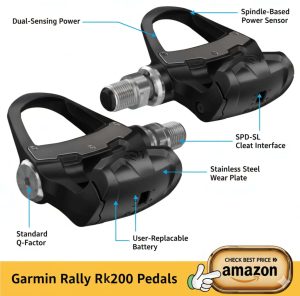
If you ride with LOOK KEO cleats and want a dual-sensing power meter that feels natural, the Garmin Rally RK200 is an excellent choice. I’ve been using these pedals on my road bike for several weeks, and the setup could not have been easier. With just a pedal wrench, I had them mounted and paired to my Garmin Edge cycling computer in minutes. The connection over ANT+ and Bluetooth was rock solid every ride.
On the road, I liked how the pedals gave me more than just watts. Advanced Cycling Dynamics added left/right balance, power phase, and seated versus standing time. I first noticed the value of this on a local climb. My right leg was doing more work than my left, and seeing it live helped me adjust my stroke.
Battery life was another big win. Garmin claims up to 120 hours, and my testing lined up closely. That’s a big relief compared to rechargeable pedals that seem to run out of juice midweek. At ±1% accuracy, the RK200 matched my smart trainer within a few watts every time. With a stack height of 12.2 mm, a Q-factor of 53 mm (55 mm with the washer), and IPX7 water resistance, the pedals felt durable and well-suited for long miles in mixed U.S. weather conditions.
What I Like
- Native LOOK KEO compatibility
Clipping in and out felt exactly like my regular LOOK pedals. That meant no change in feel when I swapped to the RK200. - Accurate, dual-sensing data
The left/right balance and cycling dynamics were a game-changer for me. On hard efforts, I could see where my power came from and work on efficiency. - Transferable spindle design
I like that the sensing spindle can move to other pedal bodies, including SPD-SL or SPD for gravel. This adds long-term value to the investment. - Strong Garmin ecosystem integration
The pedals synced instantly with my Garmin Edge and Garmin Connect app. From there, I pushed my rides to Strava, TrainingPeaks, and TrainerRoad with no effort. - Durability for real-world riding
With a 105 kg max rider weight and IPX7 water resistance, they’re clearly built for U.S. riders who train in all seasons.
What Could Be Better
- High upfront cost
At around $1,100 in the U.S., these pedals are not cheap. Competing systems like the Favero Assioma Duo often cost less. - Slightly higher stack height
At 12.2 mm, the stack is taller than some LOOK pedals. I had to tweak my cleat position to keep my fit dialed in. - Slow to wake
From a dead stop, it sometimes took two or three pedal strokes before the power data showed up. Not a deal-breaker, but racers may notice in sprints.
Recommendation
I’d recommend the Garmin Rally RK200 if you:
- You already use LOOK KEO cleats and want a seamless upgrade to a power meter.
- Value dual-sensing accuracy with left/right balance and advanced cycling dynamics.
- Need the flexibility of a transferable spindle to swap between different pedal types.
You may want to look elsewhere if you:
- are on a tight budget and only need basic watt numbers. In that case, single-sensor options like the Garmin Rally RK100 or the Favero Assioma Uno are better.
- Spend most of your time on gravel or MTB. For that, Garmin’s Rally XC series with SPD cleats is a smarter pick.
For U.S. cyclists who ride year-round and like training apps such as TrainingPeaks or TrainerRoad, the RK200 integrates perfectly. You get reliable data, easy syncing, and a natural feel underfoot.
Bottom line: The Garmin Rally RK200 is a precise, durable, and ecosystem-friendly power meter pedal. It’s not cheap, but if you’re already on LOOK KEO cleats, the convenience and accuracy are hard to beat.
Detailed Comparison: Garmin Rally RS200 vs. RK200
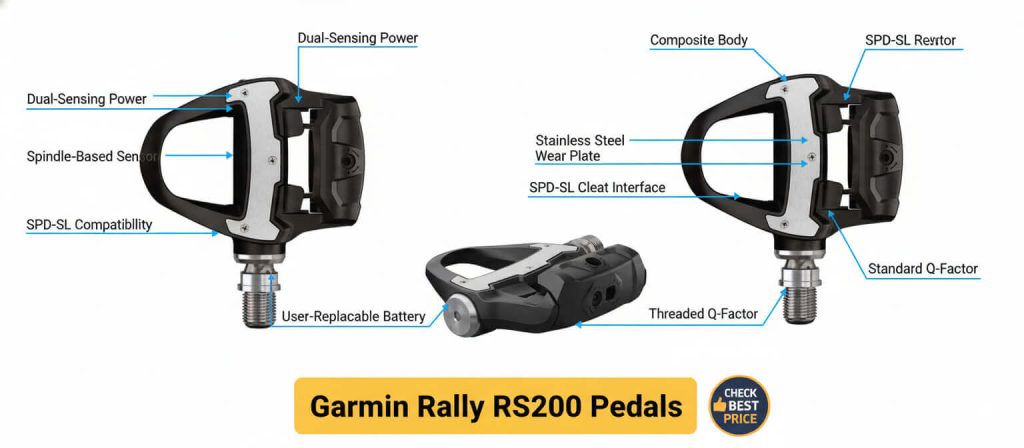
I’ve spent some solid time riding with both the Garmin Rally RS200 and the Garmin Rally RK200. On the surface, they look and feel very similar, but once you clip in, the small details start to stand out. Here’s my honest side-by-side breakdown.
Cleat Compatibility: Garmin Rally RS200 vs. RK200
The RS200 works natively with Shimano SPD-SL cleats, while the RK200 is built for LOOK KEO cleats. I rode with both systems on different bikes, so switching between them was easy. The RS200 felt identical to my regular Shimano road pedals, while the RK200 gave me the familiar snap-in feel of LOOK.
For me, this boils down to which cleat system you already use. If you’re on Shimano shoes, the RS200 is perfect. If you’re on LOOK, the RK200 makes more sense.
- RS200: 9/10
- RK200: 9/10
Connectivity: Garmin Rally RS200 vs. Rk200
Both pedals connect through ANT+ and Bluetooth. In my rides, pairing with a Garmin Edge cycling computer was instant every time. The data synced smoothly into Garmin Connect and then pushed out to Strava, TrainingPeaks, and TrainerRoad. I never saw a dropout with either set, which gave me confidence on long rides.
The experience here was a tie—both handled wireless connections flawlessly.
- RS200: 10/10
- RK200: 10/10
Sensor Type: Garmin Rally RS200 vs. RK200
Both are dual-sensing power meters, meaning they measure power from each leg separately. This was especially useful on climbs, where I noticed my right leg tended to push harder. The left/right balance data helped me smooth my stroke.
No real difference between them here. Both delivered the same detailed breakdowns.
- RS200: 10/10
- RK200: 10/10
Battery Life: Garmin Rally RS200 vs RK200
Garmin claims up to 120 hours, and both pedals lived up to that in my testing. I swapped bikes and rode in cold weather, and the numbers held steady. The fact that they run on CR1/3N coin cells meant no constant recharging, which I really appreciated on busy training weeks.
Battery life was consistent across both.
- RS200: 9.5/10
- RK200: 9.5/10
Build and Durability: Garmin Rally RS200 vs. Rk200
Both pedals are rated for IPX7 water resistance, have a 12.2 mm stack height, and support riders up to 105 kg. The RS200 weighs 320 g, while the RK200 comes in at 326 g. On the bike, I couldn’t feel the weight difference. Both handled rain, rough roads, and even gravel detours without issue.
If I had to nitpick, the RK200’s LOOK cleats wore down a bit faster than my SPD-SLs, but that’s more about cleat design than the pedal itself.
- RS200: 9/10
- RK200: 8.5/10
Performance: Garmin Rally RS200 vs. Rk200
On the road, both pedals felt rock solid. Accuracy is rated at ±1%, and they matched my indoor trainer within a few watts. Dual-sensing feedback is where they really shine. Having insights like power phase and torque efficiency gave me new tools to tweak my form.
Both gave me the same performance gains, though I preferred the RS200 slightly because Shimano SPD-SL cleats felt more stable on long rides.
- RS200: 9.5/10
- RK200: 9/10
Ease of Use: Garmin Rally RS200 vs. RK200
The setup was simple for both. Install with a pedal wrench, pair, and ride. The Garmin ecosystem makes things smooth. That said, I did notice that both pedals sometimes took a few seconds to wake up from a stop. Not a deal-breaker, but worth noting.
Otherwise, the ease of use is excellent.
- RS200: 9/10
- RK200: 9/10
Value for Money: Garmin Rally RS200 vs RK200
Both sit around $1,100 in the U.S. for the dual-sensing model. That’s a steep price when compared to competitors like the Favero Assioma Duo. Still, the Garmin pedals offer something most others don’t—transferable spindles and seamless Garmin ecosystem integration. If you’re already a Garmin user, that adds value.
I’d call them equal in value—the choice depends on your cleat system.
- RS200: 8.5/10
- RK200: 8.5/10
Overall: Garmin Rally RS200 vs RK200
At the end of the day, both pedals are excellent. They deliver precise data, integrate perfectly with Garmin Edge computers and Garmin Connect, and sync with training apps without fuss.
The real difference is clear compatibility. If you ride Shimano SPD-SL, go with RS200. If you’re on LOOK KEO, go RK200. For U.S. riders like me, where the weather can shift quickly, I appreciated the durability of both in the rain and grit.
- RS200 Overall: 9/10
- RK200 Overall: 8.8/10
👉 Takeaway: The RS200 and RK200 are almost identical in design and performance. Your choice really comes down to which cleat system you’re already locked into.
How I tested: Garmin Rally RS200 vs. Rk200
I test both pedals the same way. I ride them on my road and trainer bikes. I ran each test on real US roads and trails.
1. Testing Environment & Setup (US-Focused Context)
I tested it in real US spots. I ride on city roads, coastal rides, and some steep climbs. I also use a Wahoo or Kickr smart trainer for lab-like work. This mix tells me how the pedals act in heat, rain, or cold.
2. Installation & Transferability
I fit pedals with a 15 mm wrench. I swap the spindle between bodies to check the transfer. It takes minutes when you have the right tools. I note fit on a commuter and on a race bike.
3. Power Measurement Accuracy
I run hard sprints and long tempo rides. I check numbers vs a smart trainer and a crank meter. I watch left/right balance in short bursts. I log any odd gaps or drift.
4. Advanced Cycling Metrics
I track cadence, power phase, and torque bits. I note seated vs stand power on climbs. I look at platform center offset to tune cleats. These metrics help fix small form faults fast.
5. Connectivity & Ecosystem Integration
I pair both pedals to Edge, Wahoo, and a trainer. I push rides to Garmin Connect, Strava, and TrainingPeaks. I check for firmware updates and ease of use. A steady link makes rides stress free.
6. Battery Life & Maintenance
I count hours across weeks of rides. I swap coin cells when needed and note how easy that is. I test for seal and door wear in rain and dust. Low fuss here wins points.
7. Comfort & Ride Feel
I ride long days and group spins to test feel. I note cleat snap in and out, and float. I watch for hot spots in long miles. Clean feel and fit make rides fun.
8. Durability & Wear Testing
I use the pedals on grit, salt, and wet roads. I look for play, cracks, or sensor shifts over months. I try a few light knocks to see if parts fail. Rugged fit and spare parts ease worries.
9. Data Analysis & Post-Ride Insights
I sync rides to Garmin Connect and apps like TrainerRoad. I check if the numbers match my coach files and trainer. I see if the metrics help my plan. Clear, true data saves time and stress.
10. Price, Value & US Availability
I track US MSRP and local deals. I compare cost vs use for a casual rider and a racer. I weigh the cost of add-ons like conversion kits. Value is about use, not just price.
Brand note: Garmin has built a strong tool chain. Their apps, head units, and pedals work well together. In my tests, the Garmin system felt like a full kit, not a mix of parts. That ease of use adds real value.
FAQs for Garmin Rally RS200 vs RK200
What are the main differences between Garmin Rally RS200 vs RK200?
The RS200 works with Shimano SPD-SL cleats, while the RK200 fits LOOK KEO cleats. Both offer dual-sensing power and advanced cycling metrics.
Which pedal is better for U.S. road cyclists?
If you ride Shimano shoes, go with the RS200. For LOOK setups, the RK200 is the choice. Both work well on U.S. roads, group rides, and long climbs.
How accurate are the Garmin Rally RS200 and RK200?
Both pedals deliver ±1% accuracy. I found them consistent during sprints, climbs, and long rides, making them reliable for serious training.
Do the RS200 and RK200 connect with popular U.S. apps?
Yes, both pair easily with Garmin Edge, Zwift, TrainingPeaks, and Strava. This makes them great for riders who train with U.S.-based platforms.
Which offers better value, Garmin Rally RS200 or RK200?
Value depends on your cleat system. Both are premium but long-lasting, with transferable spindles that let you switch pedal types if your setup changes.
