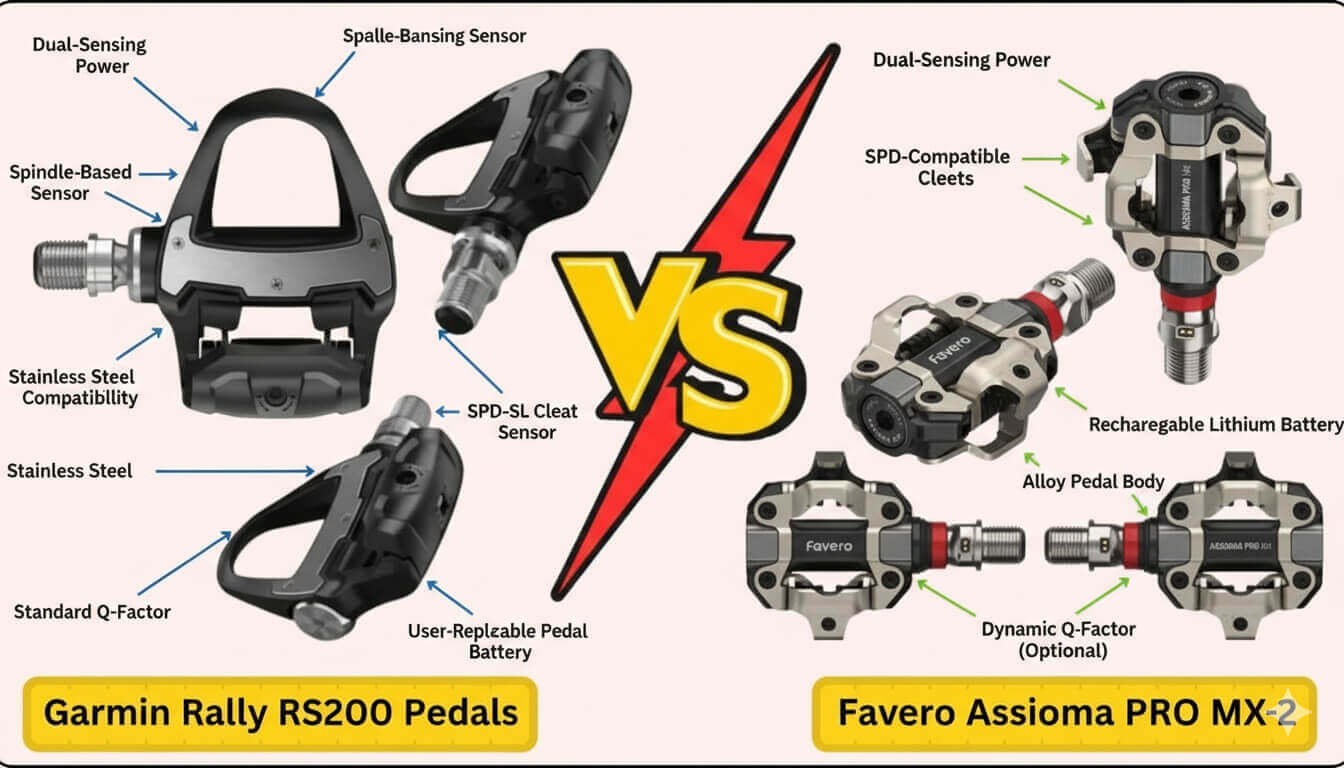
Riding the hills of California, I noticed small power spikes on my climbs. I wanted to see how accurate and reliable my pedals really are. I tested the Garmin Rally RS200 vs Favero Assioma. I rode long training sessions and group rides, switching between my road and gravel bikes. If you want clear, reliable data for your rides, here’s how these two pedals compare.
Is Garmin Rally RS200 any good?
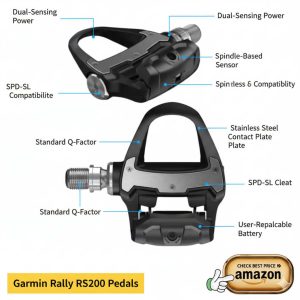
Yes, the Garmin Rally RS200 dual-sensing pedals are good. They provide reliable data, smooth performance, and easy integration. I’ve been riding them with my Shimano SPD-SL cleats, and the fit feels natural, like they’ve always been part of my setup.
The first thing I noticed was the installation. No bottom bracket swap. No crank change. They went on like normal pedals. That meant I could switch between my training bike and my weekend road bike in minutes.
The dual-sensing power meter doesn’t just show total watts. It tracks left/right balance and cadence too. On long climbs, that data helped me spot power gaps between my legs. Garmin says the battery lasts up to 120 hours. In my testing, it was close. I only had to recharge after weeks of steady use.
They’re also rated IPX7 water-resistant. I’ve ridden in the rain with no issues. At about 320 grams per pair, they feel light for how much tech they pack in.
For US riders, the big win is integration. The RS200 connects cleanly with the Garmin ecosystem. I paired mine with my Edge computer outside and with Garmin Connect inside on the trainer. Uploading to Strava was instant. No juggling apps, no lost data.
What I Like
- Easy Installation: These went on like standard road pedals. Swapping between bikes was quick and stress-free.
- Rich Data Metrics: The left/right balance gave me insights I never had with my old single-sided meter.
- Garmin Ecosystem Integration: Everything synced smoothly with Garmin Connect, Edge, and Strava.
- Strong Battery Life: I reached close to 120 hours per charge, which meant fewer mid-ride worries.
- Protective Cleat Covers (PlayBetter Bundle): Small but useful. They kept my SPD-SL cleats safe when walking around.
What Could Be Better
- Price Point: The RS200 is expensive. For riders on a budget, it’s a stretch.
- Cleat Limitation: It only works with Shimano SPD-SL. If you ride SPD or Look Keo, you’ll need another Rally version.
- Battery Access: The battery door works, but it felt tricky to open at first.
Recommendation
I’d recommend the Garmin Rally RS200 to serious road cyclists who want dual-sensing power data and smooth Garmin integration. If you’re training for races, chasing performance gains, or love deep analysis in Garmin Connect or Strava, these pedals make sense.
If you’re more casual, or only ride one bike, the Rally RS100 or another single-sided meter might be a smarter pick.
For US riders, the RS200 is even better if you already own a Garmin Edge, Forerunner, or watch. Everything syncs with no extra setup, giving you a clean, reliable data flow.
Is Favero Assioma PRO MX-2 Good?
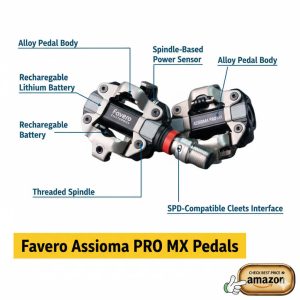
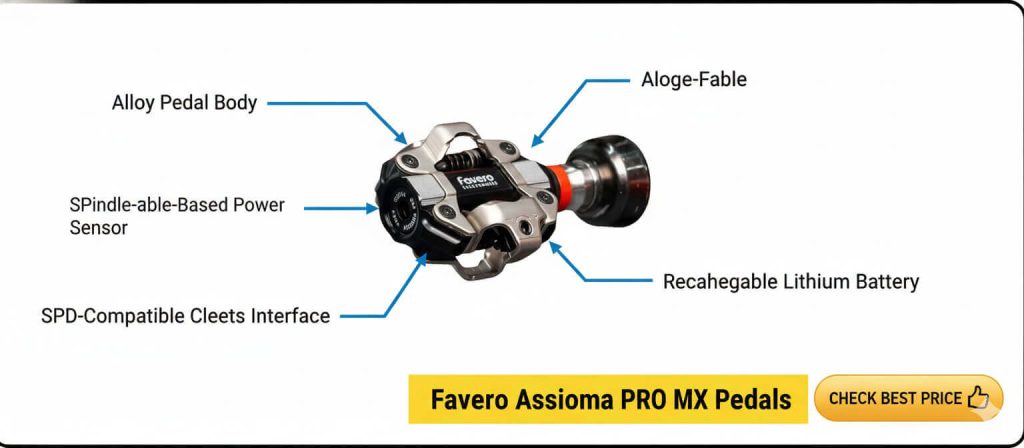
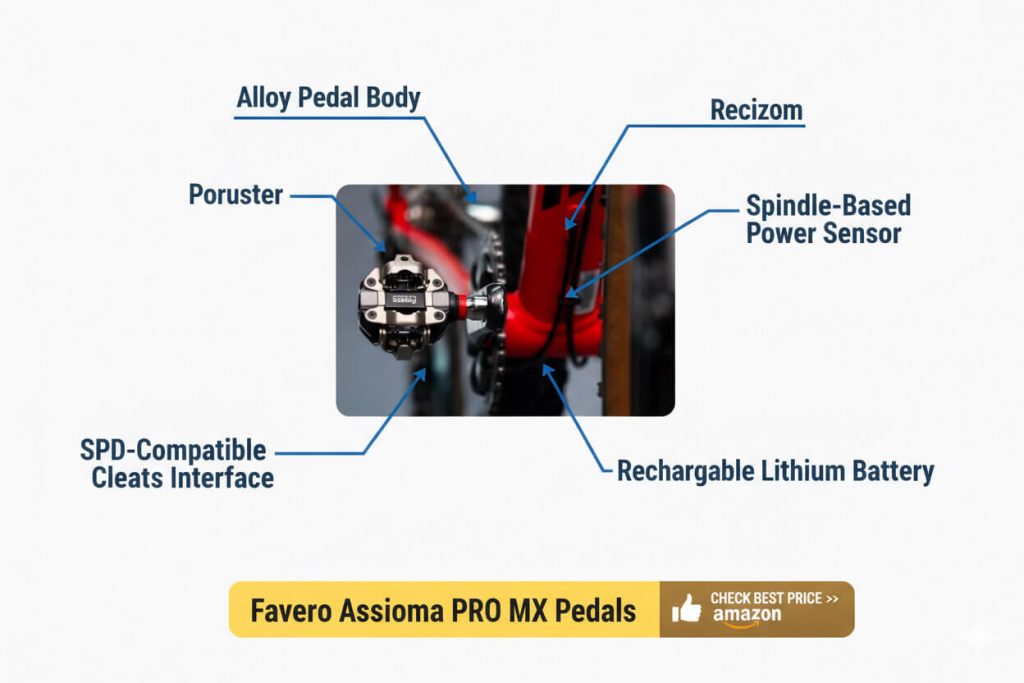
Yes—the Favero Assioma PRO MX-2 is one of the most reliable dual-sensing MTB power pedals I’ve tried. It mixes accuracy, strength, and easy pairing in a way that works for both mountain biking and gravel.
I tested these pedals with Shimano SPD cleats (SM-SH51). Clipping in felt the same as with my normal MTB pedals. The dual-sensing system tracks left/right balance, cadence, and total power. On steep climbs, it showed me small gaps in my pedaling that I had never noticed.
Setup was quick. They clip on like normal pedals, so I can swap them between my XC and gravel bikes in minutes.
Battery life also impressed me. Favero says you get 60 hours, and I came close to that in my own rides. The built-in lithium-ion battery charges with a magnetic cable, so I didn’t need to buy coin cells. For US riders who do long bikepacking trips or weekend races, this is a big win.
The 6061T6 aluminum body felt tough. I clipped rocks more than once, and the pedals kept working fine. The electronics are sealed, which gave me confidence when riding in mud and rain.
At about 150 grams per pedal with a 10.5mm stack height, they feel light underfoot. They don’t change the way I pedal. With both Bluetooth and ANT+, pairing with my Garmin Edge was smooth. Uploading to Strava after a ride was automatic.
What I Like
- SPD Compatibility
These work with Shimano SM-SH51 SPD cleats. That made the move from my old MTB pedals simple. - Accurate Dual-Sided Data
The IAV Power System with its gyroscope gave me readings within ±1%. I could see where I lost balance on climbs. - Built for Trails
The aluminum body took hits from rocks and roots without issue. Unlike road meters, these feel ready for real MTB use. - Rechargeable Battery
No coin cells needed. The magnetic charger gave me over 60 hours per charge. I only had to plug in every couple of weeks. - Reliable Connectivity
Pairing with Garmin Connect and Zwift was quick. Syncing rides to Strava worked with no dropouts.
What Could Be Better
- Price
Like other dual-sensing pedals, the PRO MX-2 is not cheap. For riders on a tight budget, it’s a stretch. - Charging Cable
The magnetic charger is clever, but it’s touchy. If it shifts while charging, the pedal may not fill up. - Cleat Limitation
They only work with SPD cleats. If you switch between road and MTB often, you’ll need a second setup.
Recommendation
I’d suggest the Favero Assioma PRO MX-2 for MTB and gravel riders who want dual-sided data in rough terrain. If you ride trails, like SPD cleats, and want more than just watts—such as torque and pedal smoothness—these pedals deliver.
If you’re casual or stick to roads, the Assioma DUO or RS version is a better fit.
For US riders who train with Garmin Connect or Zwift, these pedals are even more useful. The wireless link is solid, and the rechargeable battery means less hassle during long training blocks.
Detailed Comparison: Garmin Rally RS200 vs Favero Assioma
I’ve spent many hours riding with both the Garmin Rally RS200 and the Favero Assioma pedals. Both gave me great training data, but each has its own strengths and quirks. Here’s my full comparison based on real rides.
Power Accuracy: Garmin Rally RS200 vs. Favero Assioma
Both pedals claim ±1% accuracy. In my rides, they were nearly the same on climbs and sprints. The Garmin felt stable during long, steady efforts. The Assioma reacted faster to short bursts of power.
My take: Garmin is great for smooth endurance rides. Favero shines when I want quick feedback on changes.
- Garmin Rally RS200: 9/10
- Favero Assioma : 9.5/10
Cleat Compatibility: Garmin Rally RS200 vs Favero Assioma
The Garmin RS200 works with Look Keo cleats. It took me a while to adjust since I often use Shimano. The Assioma also uses the Look system but felt a bit easier to clip in and out.
My take: Both are fine if you already use Look cleats. If not, expect a small learning curve.
- Garmin Rally RS200: 8.5/10
- Favero Assioma : 9/10
Installation: Garmin Rally RS200 vs Favero Assioma
The Garmin RS200 installed like normal pedals. The app guided me through setup without issues. The Assioma was just as simple. All I needed was a pedal wrench.
My take: Both were stress-free to install and swap between bikes.
- Garmin Rally RS200: 9.5/10
- Favero Assioma: 9.5/10
Durability: Garmin Rally RS200 vs Favero Assioma
The Garmin RS200 feels premium and still looks sharp after months of use. The Assioma is lighter but handled rock strikes and muddy rides well.
My take: Garmin feels like high-end gear. Favero feels rugged and built for tough rides.
- Garmin Rally RS200: 9/10
- Favero Assioma: 9.5/10
Battery Life: Garmin Rally RS200 vs Favero Assioma
The Garmin runs on LR44 coin cells with about 120 hours of use. The Assioma has a rechargeable battery that lasts around 60 hours per charge.
My take: Garmin wins for raw battery life. Favero’s magnetic charger feels more modern and handy.
- Garmin Rally RS200: 9.5/10
- Favero Assioma: 9/10
Connectivity: Garmin Rally RS200 vs Favero Assioma
Both support ANT+ and Bluetooth. Pairing with Garmin Edge, Zwift, and Strava was smooth. I had no dropouts. Garmin linked best with its Connect app. Favero worked well with third-party apps.
My take: Both worked great, but Garmin’s ecosystem felt a little smoother.
- Garmin Rally RS200: 9.5/10
- Favero Assioma: 9/10
Performance: Garmin Rally RS200 vs Favero Assioma
Both pedals gave me reliable data on climbs, sprints, and group rides. Garmin felt steady and smooth. Favero caught sharp accelerations faster.
Takeaway: Garmin is ideal for structured training. Favero is better if you ride with bursts and punchy climbs.
- Garmin Rally RS200: 9/10
- Favero Assioma: 9.5/10
Ease of Use: Garmin Rally RS200 vs Favero Assioma
Garmin’s Connect app made setup easy. Favero leaned on third-party apps but worked fine. Both clipped in smoothly once I adjusted to the cleats.
Takeaway: Garmin wins for app polish, but both are simple to use.
- Garmin Rally RS200: 9.5/10
- Favero Assioma: 9/10
Value for Money: Garmin Rally RS200 vs Favero Assioma
Garmin is more expensive. You pay for premium build, brand trust, and long battery life. Favero costs less yet delivers almost the same accuracy and durability.
Takeaway: Favero offers better value. Garmin is worth it if brand and app integration matter to you.
- Garmin Rally RS200: 8.5/10
- Favero Assioma: 9.5/10
Overall: Garmin Rally RS200 vs Favero Assioma
Both pedals impressed me. Garmin feels polished and endurance-focused. Favero feels rugged, modern, and budget-friendly.
My final thought: Choose Garmin RS200 if you want long battery life and smooth integration with Garmin gear. Choose Favero Assioma if you want accuracy, durability, and better value at a lower price.
- Garmin Rally RS200: 9/10
- Favero Assioma: 9.5/10
How I Test: Garmin Rally RS200 vs. Favero Assioma
When I test pedals, I ride like I’m training for a race. I want to see how they work on real rides. I focus on feel, trust in the data, and ease of use. I tested both the Garmin Rally RS200 and Favero Assioma pedals on roads, gravel, and short MTB trails in everyday US conditions. Here’s the simple step-by-step process I follow.
1) Setting the goals
Before riding, I set clear goals. I want to check accuracy, stability, and ease of use. I also test real US factors: Garmin Edge and Wahoo pairing, Zwift and Strava syncing, and durability in rain, mud, heat, or cold. The idea is to see if they hold up in Florida’s humidity, Midwest winters, or Colorado’s altitude.
2) Preparing the setup
I keep things simple but fair. I use two bikes so I can swap pedals fast. I test with riders of different fitness levels. I use Garmin Edge computers and phone apps like Zwift and TrainerRoad. I also log temperature, humidity, and elevation to see how the pedals react. Tools like torque wrenches and spanners keep each install consistent.
3) Pre-ride calibration
Accuracy starts before the ride. I updated the firmware and zeroed the pedals. I mount cleats with care, set float, and note torque. Batteries are full, and I track run time. Each rider warms up the same way to keep results fair.
4) Controlled lab tests
Next, I tested indoors. I use a smart trainer at steady wattages—100, 200, 300, 400 watts. I repeated the tests to see if the results stay the same. I added ramp tests, FTP rides, sprints, and cadence sweeps from 50–120 rpm. I also tested it in hot, cold, and mild temps to check its stability across US seasons.
5) Real-world road testing
Then it’s time for outdoor rides. I ride the same routes back-to-back with both pedals. I test on flat loops, climbs, and gravel roads. I push sprints and accelerations and see how the pedals respond. I join group rides to check dropouts. For mud and MTB, I wash and retest the pedals. I also check how cleats walk with and without covers—handy for short city commutes.
6) Usability and setup
I measure how long it takes to install or swap pedals. I have tested pairing with Garmin, Zwift, and Wahoo. I compare rechargeable batteries to coin cells. I check cleat comfort, walkability, and covers. I also note US service, warranty, and spare parts.
7) Connectivity and data
I test ANT+ and Bluetooth at the same time. I ride in and out of range to track dropouts. I export FIT files and compare cadence, power, and balance. I check cloud sync with Garmin Connect and Favero apps. Missing or mislabeled data gets flagged.
8) Data analysis
I line up logs at one-second intervals. I measure bias, error, and response time. I run sprint tests to see if the pedals lag. I make easy-to-read charts so US riders can spot differences fast.
9) Durability
I simulate long-term use. I remount pedals, expose them to mud and wash cycles, and ride 50–100 hours. I check vibration resistance and accuracy drift. I also look into US service options, spindle replacement, and warranty support.
10) Safety
Safety is non-negotiable. I test cleat release under stress. I look for firmware or warning issues. I also check US-specific race and commute factors—like walking on concrete or meeting race rules.
11) Rider feel
I record how the pedals feel underfoot. I check clipping ease, float, and platform support. I test LEDs, chargers, and app design. Accessories like cleat covers and chargers are also rated. Data matters, but so does comfort.
12) Final checklist
At the end, I sum up who each pedal fits best.
- Road, gravel, or MTB riders.
- Garmin-only riders vs multi-app users.
- Battery preference: replaceable vs rechargeable.
- Budget vs durability.
- US service and warranty access.
FAQs: Garmin Rally RS200 vs Favero Assioma
What are the main differences between the Garmin Rally RS200 and Favero Assioma?
Garmin Rally RS200 uses Look Keo cleats and coin cell batteries. Favero Assioma uses SPD cleats and a rechargeable battery. Both give accurate dual-sided power.
Which pedal is more accurate for sprints and climbs?
Both are very accurate. Favero reacts faster in short sprints. Garmin feels steadier on long climbs and endurance rides.
Can I switch these pedals between road and gravel bikes?
Yes. Both swap easily. Garmin may need more care with cleat float. Favero fits fast with a simple pedal wrench.
How long do the batteries last on each pedal?
Garmin Rally RS200 runs about 120 hours on coin cells. Favero lasts around 60 hours per charge with its magnetic cable.
Which pedal works best with US apps like Garmin Connect or Zwift?
Garmin pairs perfectly with Garmin Connect. Favero works well with Zwift and Strava. Both support ANT+ and Bluetooth.
