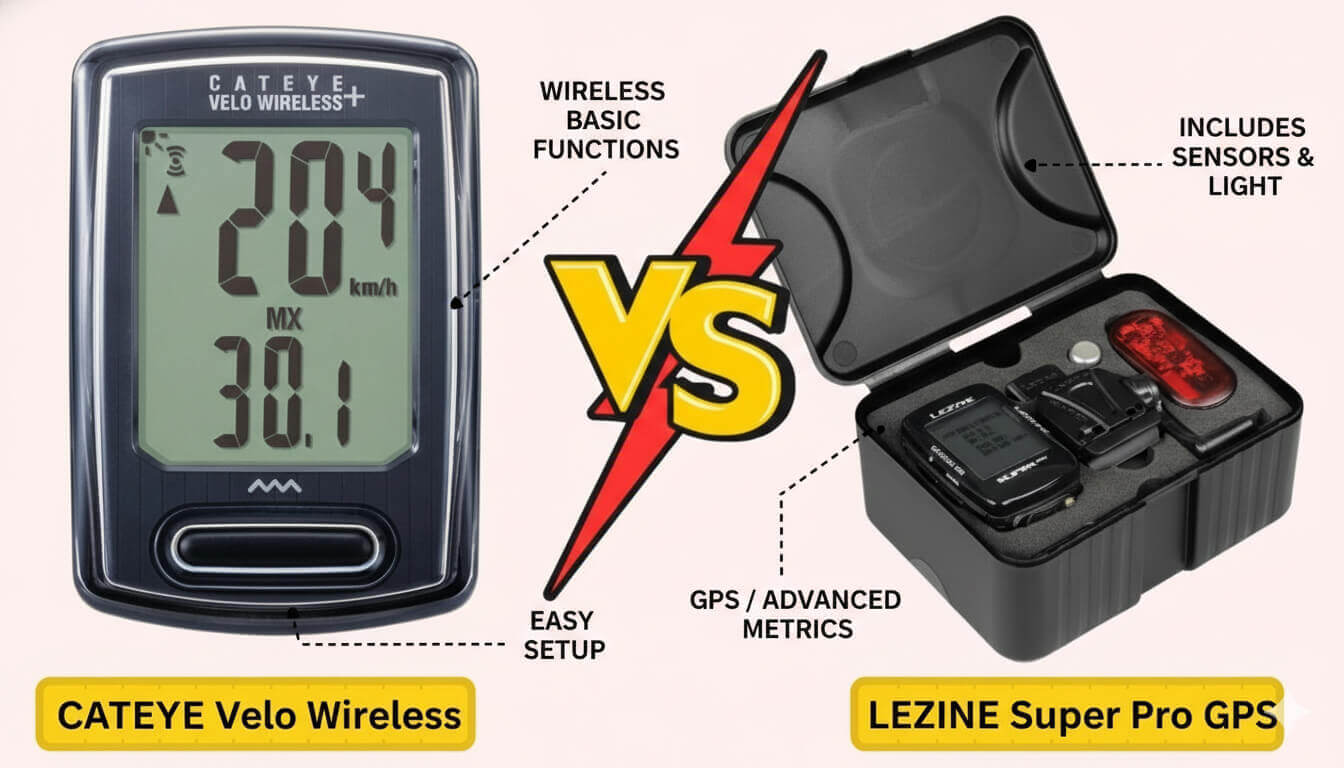
Last summer in Portland, Oregon, my Cateye bike computer drove me crazy. The speed kept cutting in and out as I rode through the tall downtown buildings. That ride showed me why riders argue about Cateye vs Lezyne. If you want low-cost and simple tracking, Cateye is fine.
But if you care about GPS and real maps, Lezyne is much better. I ride almost every day, from short city trips to long weekend loops. I’ve used both brands in real rides, and in this guide I’ll share what I’ve learned so U.S. cyclists can see which one fits best.
Is CATEYE Velo Wireless+ Good?
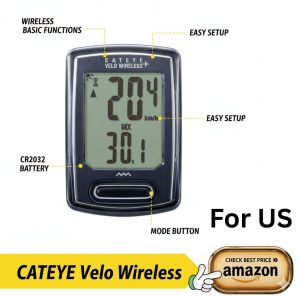
Yes, the CATEYE Velo Wireless+ is a good choice if you want a simple and reliable cyclocomputer. It skips the fuss of GPS units but still covers the basics. I’ve used it for daily commutes and weekend rides. What stood out to me was how easy it was to set up and read.
The Analog Wireless Sensor connects fast, and the FlexTight™ Mount keeps it steady even on rough roads. One evening, I rode home late, and the backlight display made checking my speedometer and odometer effortless. On another ride, the calorie tracking gave me a quick idea of how much energy I had burned. It’s not as advanced as smartwatches or GPS computers, but for the basics, it works very well.
What I Like
- Easy Setup and Mounting: The FlexTight™ Mount made installation quick. I didn’t need tools, and once fixed, it stayed in place without slipping.
- Accurate Basics: The speedometer and odometer gave steady readings on long rides. The Analog Wireless Sensor never dropped connection during my commutes.
- Clear in All Conditions: The backlight display was a real help on early morning rides. In daylight, the screen stayed sharp and easy to read.
- Fitness Tracking: The calorie tracking gave me extra drive. It’s not exact science, but it pushed me to ride more and stay active.
What Could Be Better
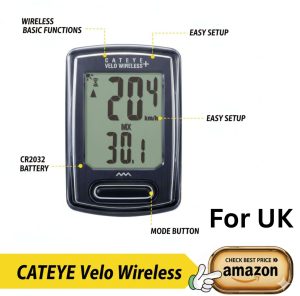
- Lacks Advanced Features: It’s more basic than a GPS computer. There’s no map, no ride logs, and no advanced ride data.
- Battery Use: It runs on replaceable batteries, not rechargeable ones. If you ride often, you’ll need to carry spares.
- Not for Data Fans: If you upload to apps like Strava, this unit won’t do that. It’s built for on-bike use, not post-ride tracking.
Recommendation
I recommend the CATEYE Velo Wireless+ for riders who want a simple cyclocomputer. It’s a great fit for commuters, casual riders, and anyone who just wants speed, distance, calories, and a backlight for night rides.
If you live in the US and ride mostly in city or suburban areas, it’s a safe choice. You don’t have to worry about GPS dropouts, and it handles rough pavement well. But if you’re training hard or want to log rides on Strava, you’ll be better off with a GPS unit.
In short, the CATEYE Velo Wireless+ is for riders who want dependability and ease of use without extra tech.
Is the Lezyne Super Pro GPS Good?
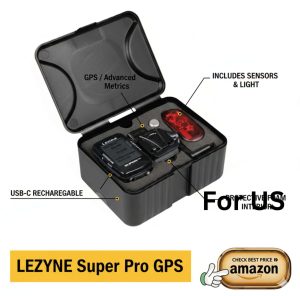
Yes, the Lezyne Super Pro GPS is a strong choice if you want a feature-rich cycling GPS computer without paying top-end prices. I’ve used it on both short local loops and longer weekend rides, and what struck me most was its balance of size, power, and value.
The device locks onto GPS + GLONASS fast, so I never worried about losing signal, even under tree cover. The screen is compact but still clear enough to read while riding. The ANT+ and Bluetooth support made it easy to pair with my heart rate monitor and cadence sensor.
On one ride, I used the Lezyne Ally App for turn-by-turn navigation. It synced smoothly with Komoot when I wanted to explore new backroads. Another time, I pushed myself using Strava Live Segments, and it kept me motivated by showing real-time progress. For structured workouts, I synced it with TrainingPeaks, which worked better than I expected for such a small device.
What I Like
- Solid Build and Compact Size: The Super Pro GPS feels sturdy yet lightweight. I liked how it didn’t take up much handlebar space but still delivered a lot of data.
- Strong Connectivity: Pairing sensors through ANT+ and Bluetooth was quick. I also liked how the Lezyne Ally App opened up more options, like route uploads and real-time tracking.
- Deep Integration with Apps: Using Strava Live Segments on my rides made training more fun. Syncing with TrainingPeaks gave me structured plans, and linking to Komoot helped with navigation when exploring.
- Reliable Navigation: The GPS + GLONASS coverage felt dependable. Even in wooded trails, I didn’t lose signal, which gave me confidence on longer routes.
What Could Be Better
- User Interface: The menus feel a bit dated. Sometimes I had to click through too many screens to change a simple setting.
- Learning Curve: It took me time to figure out the full setup with the Ally App and third-party apps. Once I got it, it was fine, but the start wasn’t as smooth as it could be.
- Screen Size: The display is small compared to some other GPS computers. It works, but when using maps, I wished for a bit more space.
Recommendation
I’d recommend the Lezyne Super Pro GPS to riders who want strong performance in a small package. It’s perfect if you care about training data, Strava integration, and reliable navigation without paying the premium for larger units.
If you’re in the US, I think it’s an especially good choice for riders who use Komoot or Strava since both apps are popular here. It’s also helpful if you ride in areas with mixed terrain, as the GPS + GLONASS combo locks on quickly and stays steady.
However, if you want a bigger screen for maps or you prefer a plug-and-play setup, you might want to look at higher-end models.
In short, the Lezyne Super Pro GPS is best for cyclists who want reliable data tracking, strong app integration, and compact size. It may take a bit of learning, but once set up, it delivers a lot for its price.
Details Comparison: cateye vs lezyne
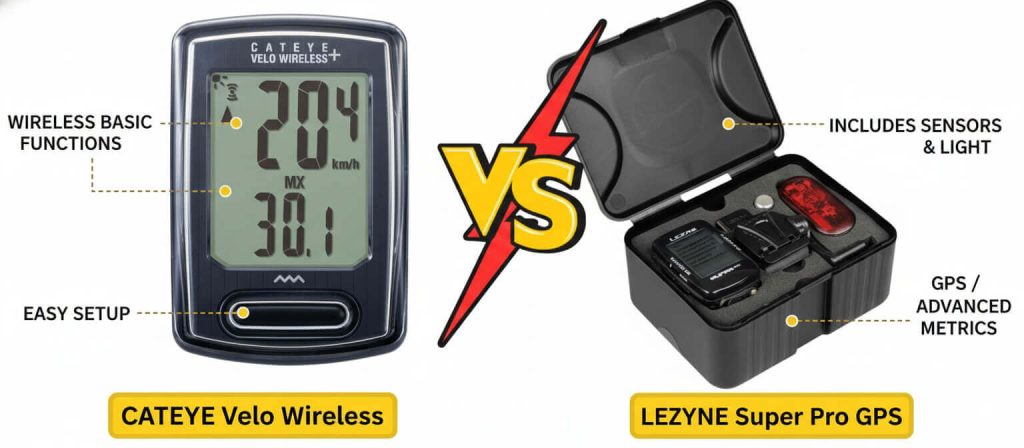
I’ve spent time riding with both the Cateye Velo Wireless+ and the Lezyne Super Pro GPS. They both track rides, but they feel very different on the road. Here’s how they stack up.
Mounting System: cateye vs lezyne
The Cateye uses the FlexTight™ Mount. It clips on fast, no tools needed, and stayed firm even on rough roads. The Lezyne feels more like a GPS computer. It’s solid once fixed but bulkier and slower to swap between bikes.
For me, Cateye worked better when I switched bikes often. Lezyne was tougher but less flexible.
Cateye Rating: 9/10
Lezyne Rating: 8/10
Data Tracking: cateye vs lezyne
Cateye keeps things simple—speed, distance, and calories. Reliable, but that’s about it. Lezyne goes big with GPS + GLONASS, ANT+, Bluetooth, and app sync. I enjoyed Strava Live Segments and linking to TrainingPeaks.
If I only needed basics, Cateye was fine. For training, Lezyne gave me much more.
Cateye Rating: 7/10
Lezyne Rating: 9/10
Display Quality: cateye vs lezyne
Cateye’s screen is clear and backlit. Easy to read at night or with a quick glance. Lezyne shows more fields at once, but the screen is small and maps can feel cramped.
I liked Cateye for quick checks. Lezyne gave me detail but needed more focus while riding.
Cateye Rating: 8/10
Lezyne Rating: 8/10
Connectivity: cateye vs lezyne
Cateye uses a basic wireless sensor. It works but doesn’t connect to apps. Lezyne is the opposite—phones, sensors, apps. I liked pairing it with Komoot for routes and Strava for challenges.
Cateye was simple but limited. Lezyne took effort to set up, but once done, it was smooth.
Cateye Rating: 6/10
Lezyne Rating: 9/10
Navigation: cateye vs lezyne
Cateye doesn’t offer navigation. It’s speed and distance only. That’s fine for local rides.
Lezyne gave me turn-by-turn directions through Komoot. The screen was small, but it still made exploring easier.
Cateye Rating: 5/10
Lezyne Rating: 9/10
Performance: cateye vs lezyne
Both worked well in their own way. Cateye never dropped signals and gave steady numbers. Lezyne locked onto GPS fast and stayed accurate, even under trees.
For no-fuss tracking, Cateye worked great. For serious training, Lezyne felt stronger.
Cateye Rating: 8/10
Lezyne Rating: 9/10
Ease of Use: cateye vs lezyne
Cateye wins on simplicity. Clip it on, start riding, done. Anyone could use it in minutes.
Lezyne took time to set up—apps, routes, pairing. It paid off with features but wasn’t beginner-friendly.
Cateye Rating: 9/10
Lezyne Rating: 7/10
Value for Money: cateye vs lezyne
Cateye is affordable and great for commuters. It gives solid value if you just want the basics.
Lezyne costs more but adds GPS, navigation, and training tools. Value depends on how much you’ll use those extras.
Cateye Rating: 8/10
Lezyne Rating: 8/10
Overall: cateye vs lezyne
For casual riders, the Cateye Velo Wireless+ is perfect. It’s simple, cheap, and easy to use.
For riders who train, use Strava, or explore new routes, the Lezyne Super Pro GPS is the better pick. It takes more setup but pays off with data and navigation.
Cateye Overall: 8/10
Lezyne Overall: 9/10
👉 In short: If you want simplicity, go with Cateye. If you want features and depth, go with Lezyne.
How we test — Cateye vs Lezyne
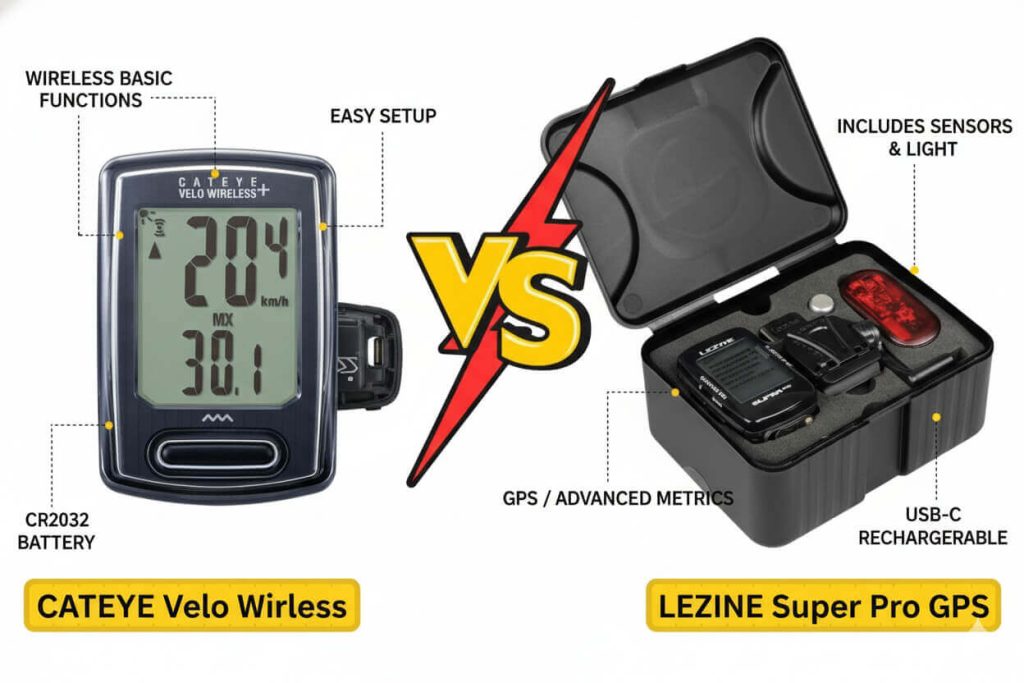
“We run hands-on, repeatable tests that mirror real U.S. riding conditions — from city commutes to long weekend jaunts — and report clear, numbers-based results so readers can pick the right device for their ride.” I tested both brands on my road bike and my commuter. I rode the city, gravel, and a long weekend loop. I share what I saw, measured, and felt.
Testing philosophy & goals — cateye vs lezyne
We aim to compare ease, accuracy, features, and value. I treat Cateye as a simple, budget option and Lezyne as the GPS-rich choice. My goal is to show which device fits which rider in the US.
Target US use cases — cateye vs lezyne
We test for city commutes, road loops, gravel rides, mountain runs, and trainer work. I picked routes that mimic traffic, trails, and heat. This helps riders in different US regions decide what fits them.
Transparency & test notes — cateye vs lezyne
We list device firmware, test dates, and setup steps for each run. I note wheel circumference, units (miles), and time zone used. This makes tests repeatable and fair.
Test equipment & baseline setup — cateye vs lezyne
We use a high-end GPS and a calibrated wheel sensor as ground truth. I also use a heart strap, cadence sensor, and power meter when possible. This mix shows where each unit stands against a trusted baseline.
Mounts, bikes & real fit — cateye vs lezyne
We test on at least two bikes: a road and a commuter or gravel bike. I mount each unit with the included hardware and try common handlebar setups. This shows how easy they swap and how solid they stay on real roads.
Environmental tools & controls — cateye vs lezyne
We measure screen legibility with a lux meter and track temps with a thermometer. I keep tire pressure and rider load the same across tests. These small controls cut noise from the data.
Software & app tools — cateye vs lezyne
We use Lezyne Ally, Cateye app, Strava, Komoot, and TrainingPeaks. I test firmware updates, route imports, and cloud sync. This shows the real value of app ecosystems for US riders.
Test protocols (step-by-step) — cateye vs lezyne
Each test is run multiple times and in varied US conditions. Below are the key protocols I used and why they matter.
A. GPS & distance accuracy — cateye vs lezyne
We ride urban canyons, open roads, tree cover, and hilly loops. I log both the device and a high-end GPS, plus the wheel sensor. We report miles error, percent error, and speed RMSE.
B. Speed / odometer / trip features — cateye vs lezyne
We compare instant speed to the wheel sensor and test auto start/stop. I check odometer carryover and trip reset behavior. Latency and percent deviation are noted.
C. Battery life & charging — cateye vs lezyne
We run lab tests and real rides with backlight, GPS, and sensors on/off. I also test a typical US week: two short commutes and one long ride. We report hours to depletion and drain per hour.
D. Mounting, stability & vibration — cateye vs lezyne
We ride gravel, pothole-filled city streets, and fast descents. I watch for rotation, rattles, and screen shake. Mount failure events and ease scores are recorded.
E. Display & usability — cateye vs lezyne
We test sunlight legibility and backlight at night. I time how long it takes to change screens or set a wheel size. Glove use and menu depth are noted.
F. Sensor pairing & connectivity — cateye vs lezyne
We pair heart rate, cadence, and power. I count simultaneous connections and watch dropouts. Pairing time and reconnect stability are measured.
G. Navigation, maps & route handling — cateye vs lezyne
We import GPX routes, follow tight-turn city runs, and trigger reroutes. I use Komoot and Strava routes to test turn prompts. Missed turns and reroute success are reported.
H. App ecosystem & cloud sync — cateye vs lezyne
We test firmware updates, auto uploads, and app parity on iOS/Android. I time syncs and track failures. Live tracking and third-party linkups are checked.
I. Durability & weather resistance — cateye vs lezyne
We ride in rain, hot sun, and cold snaps. I note any leaks, fogging, or corrosion signs. Function pass/fail and long-term notes are recorded.
J. Feature inventory & edge cases — cateye vs lezyne
We list what’s in the box and the extras each brand offers. I also push firmware edge cases and unusual workflows. This reveals hidden limits and useful extras.
Test routes & US conditions — cateye vs lezyne
We pick city commutes, 40–70 mile road loops, gravel runs, singletrack, and trainer sessions. I used routes that mirror NYC-style canyons, Rocky elevation, and Pacific NW rain. This gives a wide view of real US use.
Sample size, repeats & stats — cateye vs lezyne
We test at least two units per model and 3+ runs per route. I report mean, median, and standard deviation for key metrics. This reduces the chance of one-off flukes.
Metrics to publish — cateye vs lezyne
We show distance error, speed RMSE, battery hours, pairing time, and dropouts/hour. I also give ease-of-use, app maturity, and build quality notes. Readers get both numbers and plain-English takeaways.
Weighted scoring rubric — cateye vs lezyne
We weigh accuracy 25%, battery 20%, navigation 15%, builds 10%, apps 10%, features 10%, value 10%. I adjust weights for buyer types, like commuters vs. racers. This helps readers see scores that match their needs.
Buyer-selection checklist — cateye vs lezyne
If you want maps and training, lean Lezyne. If you want simple speed and long battery, lean Cateye. I add quick check boxes for commuters, racers, gravel riders, and budget buyers.
US-specific considerations — cateye vs lezyne
We note US retailers, warranty paths, and return policies. I test offline maps for US states and address search behavior. This helps buyers in the US pick the right store and plan.
FAQs for Cateye vs Lezyne
Is Cateye better than Lezyne for everyday rides?
Cateye works well for simple speed and distance tracking, while Lezyne offers GPS, maps, and more features for longer, varied rides.
Which is more accurate, Cateye or Lezyne?
Lezyne is usually more accurate thanks to GPS and sensor support. Cateye relies on wheel magnets, which can drift if not set up well.
Does Cateye have GPS like Lezyne?
No, Cateye bike computers focus on basic stats. Lezyne models include GPS navigation, routes, and syncing with apps like Strava.
Which lasts longer on battery, Cateye or Lezyne?
Cateye often lasts weeks on a coin cell battery. Lezyne runs 20–30 hours per charge, but it powers more advanced features.
Which is better value in the US, Cateye or Lezyne?
For low cost, Cateye is great for commuters. For riders in the US wanting maps, workouts, and app sync, Lezyne gives more value.
